


History’s most memorable firsts do not always arrive in predictable ways. Some begin with extraordinary courage, such as Roger Bannister breaking the four-minute mile after a hospital shift, while others emerge from accidents, rivalry, discrimination, or technological experimentation. This fourth collection explores 50 milestones spanning medicine, spaceflight, sports, entertainment, transportation, politics, and communication, from the first SMS and handheld cellphone call to the first crewed descent into the Mariana Trench. Together, these stories show how a single breakthrough, record, invention, or act of defiance can open doors, expose limitations, and permanently change what people believe is possible. If you missed the earlier installments, explore Part 1, Part 2, and Part 3.
1 George Williams Names Humanity’s Crimes

The first attested use of the term “crimes against humanity” came from American minister, politician, and historian George Washington Williams in 1883, when he used it while writing about slavery in the United States. Its better-known use came in 1890, after Williams met King Leopold II of Belgium and visited the Congo Free State, which Leopold controlled as his personal possession. Horrified by the widespread brutality inflicted on the Congolese people, Williams used the phrase in a letter to the U.S. secretary of state describing atrocities committed by Leopold’s administration. This 1890 usage is often cited as the phrase’s first appearance in its modern English sense.
2. The first contestant on the U.S. version of Who Wants to Be a Millionaire to answer the $1 million question incorrectly was Los Angeles entertainment lawyer Ken Basin on August 23, 2009. With $500,000 at stake, he was asked which drink President Lyndon B. Johnson could summon with an Oval Office button alongside coffee, tea, and Coke. Basin wondered whether he would regret walking away and learning he was right more than risking his winnings and being wrong, then followed his audience lifeline and chose Yoo-hoo instead of the correct answer, Fresca. The mistake cost him $475,000 and left him with $25,000.
3. The first woman to direct a film that earned more than $100 million at the U.S. box office was Penny Marshall. Her 1988 body-swap comedy Big, starring Tom Hanks, became the groundbreaking hit that carried her past the milestone. Marshall repeated the achievement with A League of Their Own in 1992, making it her second film to cross $100 million.
4. The first reported case of a sexually transmitted allergic reaction involved a 20-year-old woman with a documented Brazil nut allergy. She developed widespread hives and mild breathing difficulty after intercourse with her boyfriend, who had eaten Brazil nuts earlier. Skin-prick testing found no reaction to semen collected before he ate the nuts but significant reactivity to a sample collected afterward, supporting the researchers’ conclusion that the allergen had passed through his semen.
5. The first fully electric cargo ship was launched in China in 2017, and its designer claimed that the vessel posed “no threats to the environment.” Its 2,400-kWh lithium-ion battery could carry 2,200 tons of cargo for about 50 miles before requiring a two-hour recharge. Despite producing no carbon emissions while underway, the ship was intended primarily to haul coal to power stations along the Pearl River.
6 Mezzanine Becomes DNA Spray-Paint Album

The first album released with its audio encoded in synthetic DNA was Massive Attack’s Mezzanine. To mark its 20th anniversary in 2018, researchers compressed the album’s digital audio and converted it into 920,000 DNA fragments stored inside microscopic glass beads. The DNA was then mixed into matte-black spray paint and released in limited-edition aerosol cans, each containing approximately one million copies of the album.
7. The first call from a handheld cellular phone was made on April 3, 1973, by Motorola researcher and executive Martin Cooper. For the historic demonstration, Cooper called Joel S. Engel of Bell Labs, his rival in the race to develop cellular telephone technology. The Motorola prototype weighed 2 kilograms, provided only 30 minutes of talk time, and required 10 hours to recharge.
8. The first message transmitted over the Moscow-Washington hotline was sent by Washington on August 30, 1963: “THE QUICK BROWN FOX JUMPED OVER THE LAZY DOG’S BACK 1234567890.” The pangram and digits tested the equipment’s ability to print every letter and number, while the all-capital format was necessary because the system did not support lowercase. Soviet diplomat Andrei Gromyko later asked U.S. Secretary of State Dean Rusk what Americans meant by the strange sentence.
9. The first Black man to lead a Western capital was Cuban-born French politician Severiano de Heredia, who became president of the Paris Municipal Council in 1879. Paris had no elected mayor between 1871 and 1977, so the council presidency functioned as the city’s mayor-equivalent office. De Heredia later served in the Chamber of Deputies and briefly became France’s minister of public works in 1887.
10. The first Black astronaut selected by the United States was Air Force Major Robert Henry Lawrence Jr. in June 1967. At the announcement, a reporter asked, “Will you have to sit in the back seat of the capsule?” Lawrence and the other astronauts laughed at the question. He never reached space, dying at age 32 in an F-104 plane crash in December 1967, less than six months after his selection.
11 Cooper Union Shaft Awaited Elevator

The first purpose-built elevator shaft reportedly preceded the first modern safety passenger elevator by four years. In 1853, Peter Cooper included a cylindrical shaft in New York’s Cooper Union Foundation Building because he believed a safe passenger elevator would soon be invented. Elisha Otis installed his first safety passenger elevator in 1857 and later designed a special elevator for Cooper’s building.
12. The first and only athlete to throw a javelin beyond 100 meters was East German Uwe Hohn. On July 20, 1984, he threw 104.80 meters, shattering the previous world record of 99.72 meters. A redesigned javelin with its center of gravity moved forward by four centimeters was introduced in 1986, forcing officials to restart the records and leaving Hohn with an “eternal world record” for the old design. Although the change had been proposed before his throw, Hohn’s enormous distance accelerated its adoption because similar throws risked exceeding the available space in stadiums.
13. The first female and youngest person ever enlisted in the Royal Australian Navy was 6-year-old Nancy Bentley in 1920. After a venomous snake bit her near Port Arthur, Tasmania, her father rowed her to HMAS Sydney (I), but naval regulations prohibited civilians from receiving treatment aboard warships. Captain Henry Cayley solved the problem by formally enlisting Nancy as an honorary sailor with the official rating of “mascot” and a service term of “until fed up.” After receiving treatment, she was returned to her family and discharged following eight days of service.
14. The first gymnast to receive a perfect Olympic score was 14-year-old Romanian Nadia Comaneci during her uneven-bars routine at the 1976 Montreal Games. Because officials had assured scoreboard manufacturer Omega that a perfect 10.00 was impossible, its three-digit display could not show the score and instead flashed 1.00. Comaneci went on to earn six more perfect scores at the Games and win three gold medals.
15. The first man to run a mile in under four minutes was British runner and NHS junior doctor Roger Bannister. On May 6, 1954, he completed a morning shift at St. Mary’s Hospital in London before catching a midday train to Oxford. Later that day, he ran the mile at Oxford’s Iffley Road track in 3 minutes and 59.4 seconds, breaking a barrier many had considered unreachable.
16 Martha Cannon Defeats Her Husband

The first woman elected to a state senate in the United States was Welsh-American physician and suffragist Martha Hughes Cannon. A Mormon in a polygamous marriage, she was the fourth of six wives of prominent LDS leader Angus M. Cannon. In Utah’s November 3, 1896, election, Martha ran as a Democrat while Angus ran as a Republican for one of five at-large Senate seats. She received 10,288 votes to his 8,054, securing a seat while her husband lost his bid.
17. The first American to orbit Earth was astronaut John Glenn, who reportedly saw thousands of strange glowing particles outside Friendship 7 shortly after sunrise during his first orbit in 1962. He called the slow-moving specks “fireflies” before they vanished in brighter sunlight. Three months later, astronaut Scott Carpenter reproduced the effect by striking the wall of Aurora 7 and shaking loose tiny pieces of frost. The particles were frozen condensation from the capsule’s exterior, although later astronauts photographed their own frozen urine droplets similarly glittering in sunlight.
18. The first woman often credited with interviewing a U.S. president was American journalist Anne Royall, although the famous story of how she obtained the interview is probably apocryphal. According to the tale, Royall found President John Quincy Adams taking his customary nude morning swim in the Potomac River, gathered his clothes, and sat on them until he agreed to answer her questions.
19. The first woman to win an Olympic 100-meter title was American sprinter Betty Robinson, who claimed gold at the 1928 Amsterdam Games at age 16 in only her third 100-meter competition. In 1931, a plane crash left her severely injured, and her rescuer believed she was beyond saving and took her to Oak Forest infirmary because he knew the undertaker. Robinson spent six months in a wheelchair and two years regaining the ability to walk normally. Still unable to kneel for a standard sprint start, she returned at the 1936 Berlin Olympics and helped the United States win gold in the 4 x 100-meter relay.
20. The first single featuring rap vocals to top the U.S. Billboard Hot 100 was Blondie’s “Rapture.” Released in 1981, the new wave, disco, and hip-hop crossover spent two weeks at number one. Debbie Harry later said that members of groups including Wu-Tang Clan and Mobb Deep told her it was the first rap song they had heard.
15 Most Controversial & Costly Blunders in History
21 Convicts Form Australia’s First Police
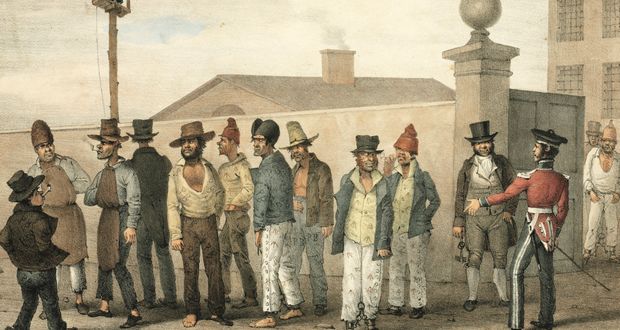
The first organized police unit in colonial Australia was staffed entirely by convicts. In August 1789, Governor Arthur Phillip selected eight of New South Wales’ best-behaved convicts to form a night watch that protected Sydney from thieves after dark. It was an early local law enforcement body rather than the modern New South Wales Police Force, which was formally established in 1862.
22. The first known person diagnosed with Alzheimer’s disease was a German woman named Auguste Deter. After she entered a Frankfurt psychiatric hospital in 1901, physician Alois Alzheimer found that she could state her first name but repeated “Auguste” when asked for her surname and lost track while trying to write it. Aware of her worsening confusion, she repeatedly said, “I have lost myself” (“Ich habe mich verloren”).
23. The first people to drive an automobile across the continental United States were physician Horatio Nelson Jackson and mechanic Sewall K. Crocker. In 1903, Jackson accepted a $50 wager that a car could cross the country in under 90 days, despite having little driving experience and not owning a car. They reached New York City after 63 days, 12 hours, and 30 minutes, having repaired their Winton repeatedly and replaced most of its original parts. When Jackson continued home to Burlington, Vermont, the drive chain, one of the few original parts remaining, snapped at the threshold of his garage.
24. The first speeding ticket was issued to a motorist zooming along at four times the legal limit. On January 28, 1896, Walter Arnold was caught driving his motorized vehicle through a Kent village at 8 mph, openly flouting the 2 mph restriction. A local police constable chased Arnold down on a regulation-issue bicycle for five miles before finally catching him and writing the citation.
25. The first machine gun was patented in 1718 with two distinct types of ammunition: round bullets for Christian enemies and square bullets for Muslim Turks. James Puckle designed his tripod-mounted, single-barreled flintlock weapon primarily as an anti-boarding gun for ships. According to Puckle’s patent, the square bullets were designed to cause more painful and severe wounds, meant to “convince the Turks of the benefits of Christian civilization.” Despite its innovation, the gun never saw combat, and only a few were ever produced.


RE: Fact #12 (Uwe Hohn Breaks Javelin Barrier) – No one has managed to break the 100-meter barrier with the new javelin designs. Jan Zelezny from the Czech Republic holds the current world record with 98.48 meters, set back in 1996.
RE: Fact #13 (Nancy Bentley Enlists After Snakebite) – Even if it wasn’t relevant here, a lot of Australians don’t realize there are specific constitutional rules that stop our armed forces from being automatically deployed to help civilians during peacetime. Even for big disasters, a civilian authority like a state premier has to formally ask the ADF for help, which then needs federal approval. It’s meant to keep politicians from using the military against its own people.
RE: Fact #35 (Liberia Becomes Africa’s Oldest Republic) – I’ve seen this fact shared a lot. A less-known piece of history is that Sierra Leone was actually established by American slaves who escaped to Canada after being promised freedom by the British. They even held elections and allowed women to vote as far back as the 1700s.
The comparison between the two is stark but insightful for understanding that era. Both were essentially commercial ventures that failed, but they had very different paths. In Sierra Leone, as in Liberia, it wasn’t just about moving free people; it was used to clear out ‘troublesome’ populations from slave states. Some states, like Maryland, even had laws requiring freed people to leave to prevent them from inspiring others to revolt. Also, both places saw high death rates among new arrivals due to disease, which only leveled off once populations with immunity, or later, ‘recaptive’ Africans freed from slavers by the Royal Navy, arrived. Both were managed poorly as private businesses, but Sierra Leone had the British government step in to make it a strategic headquarters, while Liberia was left to manage independence without stable funding or a strong commercial base, which caused huge issues later on.
RE: Fact #32 (Telharmonium Streams Music Through Telephones) – It’s wild that people used to have to find live musicians if they wanted to hear music. Back then, only royalty or the ultra-wealthy had music on demand. Now, even someone with very little money has a pocket computer that can play almost any song from anywhere in the world.
Before the mid-twentieth century, it was way more common for people to play an instrument. Even poor families often tried to own a piano. Sheet music was everywhere and people weren’t as shy about singing. You definitely had to seek out professional performances, but you’d likely hear music at home or a neighbor’s house, whether it was my dad on the harmonica or everyone singing hymns together.
RE: Fact #18 (Anne Royall’s Presidential Interview Legend) – I don’t think it was really called ‘skinny dipping’ back then. They didn’t really have swimsuits, so if you wanted to go for a swim, you just did it naked. It was just how he liked to swim.
RE: Fact #30 (El Reno Tornado Kills Chasers) – Jesus. Just before they were killed, Young mentioned how the wind grew eerily calm and there was no rain. Tim Samaras replied, “Actually, I think we’re in a bad spot.” According to a trooper on the scene, you could hear them screaming “We’re going to die” over the radio right before the impact.
I remember watching a well-made video on YouTube years ago about that incident. There were other chasers in the area who realized what was happening much faster. You can actually see the other cars fleeing while the Samaras and Young vehicle turns down the road where they were eventually caught. I’ll never really understand storm chasing, but it definitely felt like they were tempting fate that day.
RE: Fact #48 (Charles Young Rides Against Discrimination) – Born into slavery in 1864, escaping to graduate top of his class and eventually reaching the rank of Colonel, that is genuinely amazing.
RE: Fact #45 (WUSA Professionals Lose $100 Million) – It was interesting watching that play out. The US women’s World Cup team was huge and made household names of many players. I don’t recall the men’s tournament at all, but I definitely watched the women’s games. The attendance was great everywhere, it’s just a shame that didn’t lead to a sustainable league. Still, it was a massive boost for sports.
RE: Fact #18 (Anne Royall’s Presidential Interview Legend) – If that had been LBJ, not only would he have gotten out, he probably would have finished the interview while standing there completely exposed.
RE: Fact #14 (Nadia Comaneci Overloads Olympic Scoreboard) – This reminds me of the view count for Gangnam Style on YouTube. The original counter only held a certain range of numbers, and when it passed that, it hit a 32-bit integer overflow. Basically, once it went over 2.14 billion views, the system flipped to a negative number. They never figured anyone would actually hit that many views.
RE: Fact #32 (Telharmonium Streams Music Through Telephones) – I’ve been trying to track down an actual recording of this thing. Just found out no recordings are known to exist and none survived after 1920. That ends my rabbit hole. Interesting though.
RE: Fact #23 (Horatio Jackson Wins Cross-Country Wager) – With some of those old-school cars, if that drive chain snapped, you were lucky if you didn’t lose an arm in the process. It’s a miracle it didn’t turn out worse.
RE: Fact #35 (Liberia Becomes Africa’s Oldest Republic) – They were really enthusiastic about being a republic. In the 1927 election, there were 249, 000 votes cast despite having under 15, 000 registered voters. That’s true devotion to democracy, letting your voice be heard again, and again, and again.
RE: Fact #10 (Robert Lawrence Faces Racist Question) – Was that reporter trying to insult him, or were they attempting to draw attention to the fact that segregation was still going on in the U.S. despite him being chosen as an astronaut?
RE: Fact #25 (Puckle Gun Targeted Turks Differently) – Reminds me of a surgeon trying to explain things to a student: “That’s right, it goes in the square hole.”
RE: Fact #28 (Billy Haines Defies MGM Marriage) – They stayed together until Haines’ death. Joan Crawford famously called them the happiest married couple in Hollywood. When Haines passed from lung cancer in 1973, Shields took an overdose shortly after. His suicide note mentioned how he couldn’t imagine going on without William, whom he’d been with since 1926. He just felt too lonely.
RE: Fact #42 (Xerox 914 Includes Fire Extinguisher) – Problem: Machine catches fire. Solution: Rebrand as “Scorch.” Market advantage: Only Xerox features proprietary Scorch Eliminator technology.
RE: Fact #42 (Xerox 914 Includes Fire Extinguisher) – There were a few dry paper copiers around before the 914, but they were niche products that required a manual process, while automatic copiers back then used a messy, wet photographic process. Even with the risk of fire, being able to press a button and get dry copies in seconds was worth it.
RE: Fact #22 (Auguste Deter Loses Herself Slowly) – Most people with Alzheimer’s lose the ability to do basic things like feeding themselves or using the toilet once they reach the late stages. They forget everything. Many people get very confused and frightened when it starts to get dark, which leads to screaming and lashing out every night. Most of them are past the point of even acknowledging they’ve “lost themselves” because their concept of self is gone. People who haven’t experienced this personally usually think it’s just the Hollywood version, a sweet old lady who forgets a name mid-sentence. It is so much more intense than just forgetfulness.
RE: Fact #20 (Blondie’s Rapture Takes Rap Mainstream) – They also had some early rappers and DJs in that music video. I don’t remember exactly who, but I’m pretty sure Grandmaster Flash was in it.
RE: Fact #6 (Mezzanine Becomes DNA Spray-Paint Album) – As Robert Del Naja from Massive Attack said, if you sprayed the album, scraped it off the wall, and analyzed it under the right conditions, you could play the music back once the correct player exists.
RE: Fact #48 (Charles Young Rides Against Discrimination) – That is an incredible story. It’s a shame he never got that promotion, but getting such a high compliment from Teddy Roosevelt must have been a great feeling.
RE: Fact #7 (Martin Cooper Calls Bell Rival) – For some reason, I was picturing him calling his rival on a mobile phone, and then I realized that wouldn’t make any sense.
RE: Fact #4 (Brazil Nut Allergen Travels Sexually) – I once worked with a female police officer who failed a drug test for cocaine. She claimed she swallowed her boyfriend’s fluids and that he was the one using, but nobody believed her.
RE: Fact #9 (Severiano de Heredia Leads Paris) – That’s common knowledge. It’s the whole reason Jay-Z and Kanye titled their song “Niggas in Paris.”
True. >He is believed to be a cousin of the famous French poet, José-Maria de Heredia. There’s a theory that Jay-Z is a descendant of that same José-Maria de Heredia, who allegedly wrote the “Niggas in Paris” poem at a Parisian Def Poetry show back in 1861.
RE: Fact #11 (Cooper Union Shaft Awaited Elevator) – Look, anyone who has ever worked with an elevator company knows that no matter how they built the shaft and pit, it was likely all wrong and had to be redone anyway.