

26 Andrew Lyne Retracts Phantom Planet

The first planet reported to orbit another star turned out to be a mathematical error, but its retraction earned an ovation. In 1991, astronomer Andrew Lyne and his team claimed to have discovered a planetary companion around a pulsar, only to realize later they had failed to properly remove the effects of Earth’s motion from their analysis. When Lyne publicly announced his retraction and explained the mistake at an American Astronomical Society meeting, his scientific peers gave him thunderous applause for his courage and intellectual integrity.
27. The first American to appear on the Soviet children’s program “Good Night, Little Ones!” was Fred Rogers. In September 1987, Rogers traveled to Moscow to record segments for both the long-running Soviet series and Mister Rogers’ Neighborhood. His Soviet appearance aired in December 1987, during the Washington summit between Soviet leader Mikhail Gorbachev and U.S. President Ronald Reagan.
28. The first openly gay Hollywood star is widely considered to have been actor William “Billy” Haines. During the 1920s, he became a major star through films including The Midnight Express, Little Annie Rooney, and Navy Blues while sharing his life with partner Jimmie Shields. In 1933, MGM chief Louis B. Mayer reportedly ordered Haines to enter a sham marriage or give up Shields, and Haines chose his partner. MGM terminated his contract, but Haines made several minor films through 1934 before leaving acting and building a successful interior-design career.
29. The first fully trained paramedics in the world were young Black men recruited from Pittsburgh’s economically depressed Hill District in 1967, where many had been dismissed as “unemployable.” Freedom House Ambulance Service put them through an intensive 300-hour course covering anatomy, CPR, nursing, advanced first aid, medication, and emergency driving. Its five ambulances eventually handled nearly 6,000 calls annually, and the paramedics reportedly saved 200 lives during their first year. Pittsburgh replaced Freedom House with a predominantly white city service in 1975, but its training methods and medical textbook helped shape modern EMS while its pioneers were largely forgotten.
30. The first known deaths of storm chasers or meteorologists caused directly by a tornado occurred on May 31, 2013, when Tim Samaras, his 24-year-old son Paul, and meteorologist Carl Young were killed near El Reno, Oklahoma. The tornado unexpectedly changed direction and expanded from approximately 1 mile to 2.6 miles wide in about 30 seconds as it closed in on their TWISTEX vehicle. At 2.6 miles across, the El Reno tornado was the widest ever recorded.
31 Greg LeMond Wins Despite Buckshot

The first American cyclist to win the Tour de France twice was Greg LeMond, whose 1989 victory completed a remarkable comeback. Two years earlier, he had been accidentally shot in the back and side with approximately 60 shotgun pellets during a turkey hunt, causing him to lose about 65% of his blood volume. LeMond won the Tour with 35 pellets still embedded in his body, including three in the lining of his heart and five in his liver. He won again in 1990 and remains the only American officially credited with a Tour de France victory.
32. The world’s first music-streaming service used the Telharmonium, a 200-ton electrical instrument patented in 1897 and introduced commercially in New York in 1906. Subscribers asked telephone operators to connect them to a central “music plant” at Broadway and 39th Street, which transmitted live music to receivers fitted with paper funnels for amplification. Two musicians reportedly played customized keyboards continuously, 24 hours a day, allowing listeners to turn live music on and off like a household utility. The service reached the public in 1907, but interference with telephone calls and enormous operating costs caused it to close in 1916.
33. The first exceptionally clear X-ray diffraction image of DNA’s B form was Photo 51, produced in 1952 through research led by British chemist Rosalind Franklin. Her doctoral student Raymond Gosling captured the image while working under her supervision at King’s College London. Maurice Wilkins later showed it to James Watson without Franklin’s knowledge or permission, and Watson and Francis Crick used its features alongside other evidence to construct their double-helix model. The 1962 Nobel Prize was awarded to Watson, Crick, and Wilkins, while Franklin had passed away in 1958, and the prize committee did not acknowledge Gosling’s contribution.
34. The first official Social Security record belonged to John David Sweeney Jr., a 23-year-old shipping clerk from New Rochelle, New York. On December 1, 1936, an official selected Sweeney’s record from the first block of 1,000 processed applications and designated it as the symbolic first, although many cards had already been issued elsewhere. Sweeney contributed to the program but died of a heart attack in 1974 at age 61, before receiving any retirement benefits. His widow later collected survivor benefits based on his contributions until her death in 1982.
35. The first African republic to declare independence was Liberia, which remains Africa’s oldest continuously independent country. The American Colonization Society established its first settlement there in 1822 to create a self-sufficient colony for free-born and formerly enslaved Black Americans, and Liberia declared independence in 1847. Its capital, Monrovia, was named after U.S. President James Monroe, a prominent supporter of the colonization project.
36 Maria Daume Completes Infantry Training
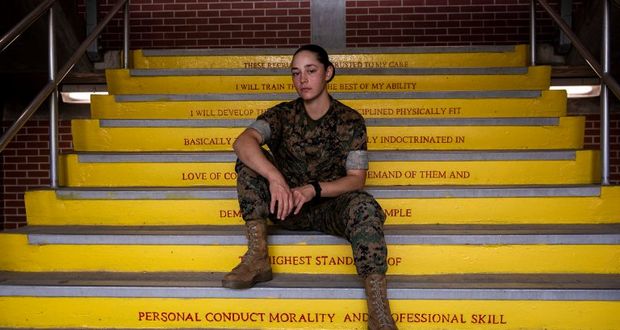
The first woman to join the U.S. Marine Corps infantry through the traditional entry-level training process was Maria Daume. Born in a Siberian prison, she was orphaned at age 2, adopted by Americans at 4, and raised in New York. In 2017, she graduated near the top of her class as a mortar marine, only six months after the training process opened to women.
37. The first crewed vessel to reach the bottom of the Mariana Trench was the bathyscaphe Trieste. During its descent on January 23, 1960, an outer Plexiglas window pane cracked after the vessel passed 9,000 meters, shaking the entire craft. Pilots Jacques Piccard and Don Walsh continued and successfully reached Challenger Deep at a depth of approximately 10,916 meters, where they spent 20 minutes on the ocean floor.
38. The first woman in Asia to receive a bilateral above-elbow hand transplant was Indian engineering student Shreya Siddanagowder, who lost both hands in a bus accident in 2016. In 2017, she underwent a 13-hour operation using limbs from a 21-year-old male donor. Although the transplanted hands were initially darker and hairier, they gradually became lighter and more feminine in appearance, bringing their color closer to her natural skin tone. Doctors suspect her body’s lower melanin production contributed to the change.
39. The first African American ophthalmology resident at New York University was Dr. Patricia Bath, who completed her training there in 1973. She later invented the Laserphaco Probe, a minimally invasive device that used a laser to remove cataracts and helped patients around the world regain their sight. When Bath patented the device in 1988, she became the first Black female physician in the United States to receive a patent for a medical invention.
40. The first road vehicle to exceed 100 km/h (62 mph) was an electric car named La Jamais Contente. In 1899, Belgian driver Camille Jenatzy drove the torpedo-shaped vehicle at 105.882 km/h (65.792 mph) near Paris, breaking the previous land-speed record. Despite this achievement, gasoline-powered vehicles soon overtook electric cars and dominated the following century.
41 Robert Odlum’s Brooklyn Bridge Fatality

The first man to jump from the Brooklyn Bridge was American swimming instructor Robert Emmet Odlum in 1885. He hoped to demonstrate that people did not die simply from falling through the air, believing the act would encourage those trapped in burning buildings to jump into safety nets. A strong wind turned him during the fall, causing him to strike the water at an angle with his feet and right hip. He died 43 minutes later, and an autopsy listed concussion as the cause of death while also finding three broken ribs and several ruptured organs.
42. The first commercially successful plain-paper photocopier was the Xerox 914, introduced in 1959. Because the mechanically complex machine tended to overheat and catch fire, Xerox supplied each unit with a “scorch eliminator,” which was simply a small fire extinguisher. One of the two copiers at its televised public debut caught fire, while consumer advocate Ralph Nader reported that his office machine caught fire three times in four months.
43. The first permanently staffed mountaintop observatory in the world was Lick Observatory, completed in 1888 using a $700,000 bequest from James Lick, once California’s wealthiest man. The observatory was given to the University of California and housed the world’s largest refracting telescope at the time. In 1887, Lick’s body was reburied beneath the future telescope site, and his will stipulated that fresh flowers be placed on his grave “always.”
44. The first official circulation coin of the United States was the Fugio cent, authorized by Congress in 1787. Its designer is unknown but traditionally believed to have been Benjamin Franklin, whose earlier currency used similar imagery. The front displayed a sun and sundial with the words “Fugio” and “Mind Your Business,” while the reverse showed 13 linked rings representing the original states around the motto “We Are One.”
45. The first women’s soccer league in which every player was paid as a professional was the Women’s United Soccer Association. Founded in 2000 following the popularity of the 1999 FIFA Women’s World Cup, it began playing in 2001 with eight U.S. teams. The league spent a five-year, $40 million budget during its first season and suspended operations in 2003 after three seasons and cumulative losses of approximately $100 million.
15 Most Controversial & Costly Blunders in History
46 David Wolf Votes From Orbit

The first American astronaut to vote from space was David Wolf, who cast an electronic absentee ballot from Russia’s Mir space station in 1997. Texas created the procedure after astronaut John Blaha was unable to vote during his 1996 Mir mission because his flight began before absentee ballots were finalized. Astronauts registered in Texas, where NASA’s Johnson Space Center is located, can receive secure electronic ballots while listing their current address as “low-Earth orbit.”
47. The first production car to explore Antarctica was a ruby-red Volkswagen Beetle named Antarctica 1, donated by Volkswagen in 1963. It spent a year at Australia’s remote Mawson Station, enduring temperatures of -52 C and winds reaching 200 km/h. Its air-cooled engine never froze, and its tightly sealed body resisted drifting snow so effectively that the scientists nicknamed it the “Red Terror.” After returning to Australia with only minor repairs, it won the 1964 BP Rally.
48. The first Black man to achieve the rank of colonel in the U.S. Army was Charles Young in 1917. Although he was positioned for promotion to brigadier general during World War I, resistance from white officers led the War Department to remove him from active duty, officially citing high blood pressure. In 1918, Young rode on horseback from Wilberforce, Ohio, to Washington, D.C., to demonstrate his physical fitness. He was reinstated as a colonel later that year, although the Army did not fully rescind his forced retirement.
49. The first SMS text message was sent on December 3, 1992, by 22-year-old British test engineer Neil Papworth. Because mobile phones could not yet send text messages, Papworth transmitted it from a computer over Vodafone’s network to an Orbitel 901 phone carried by company director Richard Jarvis. The historic message contained just two words: “Merry Christmas.”
50. The first Black actor to have a recurring role on a children’s television show was François Clemmons, whom Fred Rogers cast as Officer Clemmons on Mister Rogers’ Neighborhood in 1968. Clemmons initially hesitated to portray a police officer because law enforcement had not been a friendly presence in the neighborhood where he grew up. In 1969, Rogers invited Clemmons to cool his feet beside him in a small pool, creating a widely recognized statement against racial segregation.


RE: Fact #12 (Uwe Hohn Breaks Javelin Barrier) – No one has managed to break the 100-meter barrier with the new javelin designs. Jan Zelezny from the Czech Republic holds the current world record with 98.48 meters, set back in 1996.
RE: Fact #13 (Nancy Bentley Enlists After Snakebite) – Even if it wasn’t relevant here, a lot of Australians don’t realize there are specific constitutional rules that stop our armed forces from being automatically deployed to help civilians during peacetime. Even for big disasters, a civilian authority like a state premier has to formally ask the ADF for help, which then needs federal approval. It’s meant to keep politicians from using the military against its own people.
RE: Fact #35 (Liberia Becomes Africa’s Oldest Republic) – I’ve seen this fact shared a lot. A less-known piece of history is that Sierra Leone was actually established by American slaves who escaped to Canada after being promised freedom by the British. They even held elections and allowed women to vote as far back as the 1700s.
The comparison between the two is stark but insightful for understanding that era. Both were essentially commercial ventures that failed, but they had very different paths. In Sierra Leone, as in Liberia, it wasn’t just about moving free people; it was used to clear out ‘troublesome’ populations from slave states. Some states, like Maryland, even had laws requiring freed people to leave to prevent them from inspiring others to revolt. Also, both places saw high death rates among new arrivals due to disease, which only leveled off once populations with immunity, or later, ‘recaptive’ Africans freed from slavers by the Royal Navy, arrived. Both were managed poorly as private businesses, but Sierra Leone had the British government step in to make it a strategic headquarters, while Liberia was left to manage independence without stable funding or a strong commercial base, which caused huge issues later on.
RE: Fact #32 (Telharmonium Streams Music Through Telephones) – It’s wild that people used to have to find live musicians if they wanted to hear music. Back then, only royalty or the ultra-wealthy had music on demand. Now, even someone with very little money has a pocket computer that can play almost any song from anywhere in the world.
Before the mid-twentieth century, it was way more common for people to play an instrument. Even poor families often tried to own a piano. Sheet music was everywhere and people weren’t as shy about singing. You definitely had to seek out professional performances, but you’d likely hear music at home or a neighbor’s house, whether it was my dad on the harmonica or everyone singing hymns together.
RE: Fact #18 (Anne Royall’s Presidential Interview Legend) – I don’t think it was really called ‘skinny dipping’ back then. They didn’t really have swimsuits, so if you wanted to go for a swim, you just did it naked. It was just how he liked to swim.
RE: Fact #30 (El Reno Tornado Kills Chasers) – Jesus. Just before they were killed, Young mentioned how the wind grew eerily calm and there was no rain. Tim Samaras replied, “Actually, I think we’re in a bad spot.” According to a trooper on the scene, you could hear them screaming “We’re going to die” over the radio right before the impact.
I remember watching a well-made video on YouTube years ago about that incident. There were other chasers in the area who realized what was happening much faster. You can actually see the other cars fleeing while the Samaras and Young vehicle turns down the road where they were eventually caught. I’ll never really understand storm chasing, but it definitely felt like they were tempting fate that day.
RE: Fact #48 (Charles Young Rides Against Discrimination) – Born into slavery in 1864, escaping to graduate top of his class and eventually reaching the rank of Colonel, that is genuinely amazing.
RE: Fact #45 (WUSA Professionals Lose $100 Million) – It was interesting watching that play out. The US women’s World Cup team was huge and made household names of many players. I don’t recall the men’s tournament at all, but I definitely watched the women’s games. The attendance was great everywhere, it’s just a shame that didn’t lead to a sustainable league. Still, it was a massive boost for sports.
RE: Fact #18 (Anne Royall’s Presidential Interview Legend) – If that had been LBJ, not only would he have gotten out, he probably would have finished the interview while standing there completely exposed.
RE: Fact #14 (Nadia Comaneci Overloads Olympic Scoreboard) – This reminds me of the view count for Gangnam Style on YouTube. The original counter only held a certain range of numbers, and when it passed that, it hit a 32-bit integer overflow. Basically, once it went over 2.14 billion views, the system flipped to a negative number. They never figured anyone would actually hit that many views.
RE: Fact #32 (Telharmonium Streams Music Through Telephones) – I’ve been trying to track down an actual recording of this thing. Just found out no recordings are known to exist and none survived after 1920. That ends my rabbit hole. Interesting though.
RE: Fact #23 (Horatio Jackson Wins Cross-Country Wager) – With some of those old-school cars, if that drive chain snapped, you were lucky if you didn’t lose an arm in the process. It’s a miracle it didn’t turn out worse.
RE: Fact #35 (Liberia Becomes Africa’s Oldest Republic) – They were really enthusiastic about being a republic. In the 1927 election, there were 249, 000 votes cast despite having under 15, 000 registered voters. That’s true devotion to democracy, letting your voice be heard again, and again, and again.
RE: Fact #10 (Robert Lawrence Faces Racist Question) – Was that reporter trying to insult him, or were they attempting to draw attention to the fact that segregation was still going on in the U.S. despite him being chosen as an astronaut?
You’d probably have to ask the reporter himself, since it seems like nobody was even sure if he was being serious or not.
RE: Fact #25 (Puckle Gun Targeted Turks Differently) – Reminds me of a surgeon trying to explain things to a student: “That’s right, it goes in the square hole.”
RE: Fact #28 (Billy Haines Defies MGM Marriage) – They stayed together until Haines’ death. Joan Crawford famously called them the happiest married couple in Hollywood. When Haines passed from lung cancer in 1973, Shields took an overdose shortly after. His suicide note mentioned how he couldn’t imagine going on without William, whom he’d been with since 1926. He just felt too lonely.
RE: Fact #42 (Xerox 914 Includes Fire Extinguisher) – Problem: Machine catches fire. Solution: Rebrand as “Scorch.” Market advantage: Only Xerox features proprietary Scorch Eliminator technology.
RE: Fact #42 (Xerox 914 Includes Fire Extinguisher) – There were a few dry paper copiers around before the 914, but they were niche products that required a manual process, while automatic copiers back then used a messy, wet photographic process. Even with the risk of fire, being able to press a button and get dry copies in seconds was worth it.
Xerox also invented the first office PC, complete with a GUI and a full suite of standard office software. The original ad is pretty adorable, too.
RE: Fact #22 (Auguste Deter Loses Herself Slowly) – Most people with Alzheimer’s lose the ability to do basic things like feeding themselves or using the toilet once they reach the late stages. They forget everything. Many people get very confused and frightened when it starts to get dark, which leads to screaming and lashing out every night. Most of them are past the point of even acknowledging they’ve “lost themselves” because their concept of self is gone. People who haven’t experienced this personally usually think it’s just the Hollywood version, a sweet old lady who forgets a name mid-sentence. It is so much more intense than just forgetfulness.
RE: Fact #20 (Blondie’s Rapture Takes Rap Mainstream) – They also had some early rappers and DJs in that music video. I don’t remember exactly who, but I’m pretty sure Grandmaster Flash was in it.
RE: Fact #6 (Mezzanine Becomes DNA Spray-Paint Album) – As Robert Del Naja from Massive Attack said, if you sprayed the album, scraped it off the wall, and analyzed it under the right conditions, you could play the music back once the correct player exists.
RE: Fact #48 (Charles Young Rides Against Discrimination) – That is an incredible story. It’s a shame he never got that promotion, but getting such a high compliment from Teddy Roosevelt must have been a great feeling.
RE: Fact #7 (Martin Cooper Calls Bell Rival) – For some reason, I was picturing him calling his rival on a mobile phone, and then I realized that wouldn’t make any sense.
RE: Fact #4 (Brazil Nut Allergen Travels Sexually) – I once worked with a female police officer who failed a drug test for cocaine. She claimed she swallowed her boyfriend’s fluids and that he was the one using, but nobody believed her.
RE: Fact #9 (Severiano de Heredia Leads Paris) – That’s common knowledge. It’s the whole reason Jay-Z and Kanye titled their song “Niggas in Paris.”
True. >He is believed to be a cousin of the famous French poet, José-Maria de Heredia. There’s a theory that Jay-Z is a descendant of that same José-Maria de Heredia, who allegedly wrote the “Niggas in Paris” poem at a Parisian Def Poetry show back in 1861.
RE: Fact #11 (Cooper Union Shaft Awaited Elevator) – Look, anyone who has ever worked with an elevator company knows that no matter how they built the shaft and pit, it was likely all wrong and had to be redone anyway.