

26 New York Times Pentagon Papers

In June 1971, The New York Times began publishing excerpts from the Pentagon Papers, a secret Defense Department history of U.S. involvement in Vietnam. The paper argued in court that the press had a First Amendment right to publish information vital to the public’s understanding of its government’s policies, even when that information came from classified documents. The Nixon administration tried to stop further publication through injunctions, triggering a major legal battle over prior restraint. Later that same month, the Supreme Court ruled in New York Times Co. v. United States that the government had not met the heavy burden needed to justify censorship, and the Times continued releasing the Pentagon Papers to the public.
27. In 2003, the Pentagon backed an online “terror futures” market that let participants bet on events such as future assassinations, terror attacks, and coups in the Middle East. The project, run through DARPA and called the Policy Analysis Market, aimed to use market forces and expert bets to predict political instability and security threats. When news reports revealed that traders could profit by wagering on things like the assassination of foreign leaders, lawmakers from both parties condemned the idea as grotesque and morally wrong. Under intense political pressure and public outrage, the Pentagon shut the program down before it fully launched.
28. Jack Ryan was a Yale-trained engineering graduate who began his career designing missiles for the Pentagon. He then redirected that engineering expertise into creating the Barbie doll.
29. The Pentagon relies on a civilian law enforcement agency, not a military guard unit, for its day-to-day protection. The Pentagon Force Protection Agency (PFPA) provides security, anti-terrorism measures, and police services for the Pentagon Reservation and certain other Department of Defense facilities.
30. In 1999, a 15-year-old hacker using the alias “c0mrade” broke into NASA computers at the Marshall Space Flight Center in Huntsville, Alabama, and downloaded 1.7 million dollars’ worth of proprietary software that controlled the International Space Station’s temperature and humidity. NASA responded by shutting down the affected systems for 21 days to check the damage, a move that cost about 41,000 dollars in contractor labor and required equipment replacements. During the same period, he also hacked into a Pentagon computer network run by the Defense Threat Reduction Agency, whose mission is to reduce threats from nuclear, biological, chemical, conventional, and special weapons, intercepting about 3,300 emails and collecting multiple user names and passwords. He later pleaded guilty in federal court to juvenile delinquency for the NASA and Pentagon intrusions.
31 Pentagon 2000 Passenger Plane Drill

In late October 2000, just 11 months before 9/11, Pentagon emergency planners ran a mass casualty exercise that simulated a downed passenger aircraft billowing fire and smoke in the Pentagon courtyard. In this particular scenario, planners counted 341 simulated victims as medical officers requested helicopters and coordinated triage.
32. Noam Chomsky not only worked for the US military during the first decades of his MIT career, but he also worked with a Pentagon contractor after retiring from MIT in the early 2020s. He spent his early MIT years doing Pentagon-related work, with his linguistics research supported by military funding.
33. On September 11, 2001, Lieutenant General Timothy Maude, the Army’s Deputy Chief of Staff for Personnel, was working in his Pentagon office when American Airlines Flight 77 struck the building. He died in the attack, becoming the highest-ranking U.S. military officer killed by foreign action since World War II. His death came just days before his office was scheduled to move out of the section of the Pentagon that the hijacked plane destroyed.
34. In 1990, Congress passed the Chief Financial Officers Act and initially gave the Pentagon until 1997 to be ready for a clean financial audit, later pushing the target date out to 2017. Instead of meeting those deadlines, the Defense Department finally underwent its first ever full, department-wide financial statement audit for fiscal year 2018, covering about 2.7 trillion dollars in assets and 2.6 trillion in liabilities. Auditors issued a disclaimer of opinion and reported major weaknesses in inventory records, IT systems, and internal controls, and Pentagon officials openly acknowledged that they had failed the audit. The department has repeated the audit every year since but still has not earned a clean, department-wide opinion, even though some components, such as the Marine Corps, have started getting unmodified opinions, and Congress now expects a full clean audit by the end of 2028.
35. In 2002, the Pentagon ran a massive war game called Millennium Challenge that cost about 250 million dollars and involved roughly 13,000 troops in a simulation against a generic rogue state. The U.S. side deployed high-tech sensors, networked command systems, and overwhelming firepower, while the opposing “Red” team used simpler tactics to test the limits of that technology. To the surprise of Pentagon planners, the U.S. forces effectively lost the simulation when the enemy side managed to inflict heavy damage early in the exercise. The outcome raised uncomfortable questions inside the Defense Department about overconfidence in complex systems and how a determined adversary might exploit their weaknesses.
36 UC Santa Cruz Pentagon Threat

In April 2005, student activists at the University of California, Santa Cruz, a famously liberal campus, staged loud protests against military recruiters at a career fair and eventually drove them off campus. A Pentagon surveillance program known as TALON logged the action and labeled the student opposition a “credible threat” to military recruiters, the only campus antiwar protest in the database to receive that designation.
37. On September 11, 1941, the U.S. War Department held the groundbreaking ceremony for the Pentagon in Arlington, Virginia. Exactly 60 years later, on September 11, 2001, American Airlines Flight 77 slammed into the building on the anniversary of that first shovel of dirt. At the time of the attack, the Pentagon was nearing the end of a major renovation, and the plane hit a section that had recently been reinforced and partly emptied for construction. Nearly 200 people died, but the upgraded structure and blast-resistant windows helped prevent the death toll from climbing even higher.
38. For years, the Pentagon staged arrival ceremonies that honored fallen soldiers but did not depict their actual return to U.S. soil. When questions arose, officials released a statement admitting that these were “pre-planned ceremonies” that were “symbolic in nature, with the purpose of honoring those Americans who made the ultimate sacrifice in support of our nation.” The wording acknowledged that the events audiences watched were carefully scripted rituals rather than real-time homecomings.
39. In August 1949, a U.S. Army Special Operations Division team from Fort Detrick carried out the first large-scale American biological warfare vulnerability test inside the Pentagon in Washington, D.C. Operatives sprayed harmless bacteria into the building’s air conditioning system to mimic how a real biological agent might be released. They then tracked how the microbes moved through ducts, offices, and corridors as the air system ran. The experiment showed that a single release into the ventilation could spread biological material throughout the entire headquarters.
40. The Pentagon sits physically in Arlington, Virginia, but the building uses six Washington, D.C., ZIP codes instead of a Virginia address. One ZIP code serves each of the five armed services, another covers the Joint Chiefs of Staff, and a sixth belongs to the Secretary of Defense.
41 Donald Rumsfeld Pentagon Crash Response
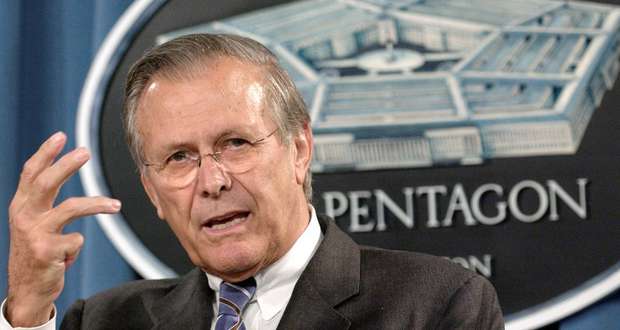
On the morning of September 11, 2001, Secretary of Defense Donald Rumsfeld sat in his Pentagon office when American Airlines Flight 77 slammed into the building. Instead of heading immediately to a secure command center, he rushed down to the crash site, walked through the smoke and debris, and personally inspected the damage while helping with the initial response. During this period, he was effectively out of communication with the national command structure for about 20 minutes while the United States was under attack.
42. Off the coast of Long Island, New York, the U.S. government uses remote Plum Island, a highly restricted Department of Homeland Security facility, to run Pentagon-backed cyber war games on the power grid. Every six months, DARPA ferries specialists to the island, where they practice responding to a worst-case scenario in which hackers knock out a large section of the U.S. electric system. On the island’s isolated grid, teams work to jumpstart dead infrastructure while fending off simulated cyberattacks.
43. In 2010, retired Army Reserve intelligence officer Lt. Col. Anthony Shaffer published a memoir about his Afghanistan service titled Operation Dark Heart. After the Pentagon reviewed the manuscript and claimed that about 250 pages contained classified information, the Department of Defense paid roughly 47,000 dollars to buy all 9,500 copies of the first printing from the publisher and ordered them destroyed. The books were pulped under Pentagon supervision so the uncensored text would not reach the public.
44. During the Cold War, Western analysts called Kremlinologists faced a Soviet government that revealed almost nothing about who held real power in Moscow. With so little official information, they closely watched Red Square parades and other public events, studying which leaders appeared, which did not, and where each man stood in the lineup. They timed the gaps between officials, noted who stood closer to the top leader, and tracked who moved farther away over time. By dissecting these small visual cues, Kremlinologists tried to determine who was rising, who was fading, and how the balance of power inside the Kremlin shifted from year to year.
45. For most of its history, the Pentagon had only one passenger elevator, which the Secretary of Defense used to ride from the parking garage up to his office while nearly everyone else relied on ramps and stairs. The building’s original design focused on moving huge numbers of people horizontally through long corridors rather than vertically between floors. During the massive renovation project that stretched from the 1990s into 2011, engineers modernized the interior and added more elevators to meet contemporary accessibility and safety standards.
15 Most Controversial & Costly Blunders in History
46 Pentagon School Of The Americas

The School of the Americas was an institution run by the Pentagon that trained personnel from what officials called the Third World. Critics charged that the school did not just teach basic military skills but trained various militias to terrorize citizens in their home countries. In their view, Pentagon-backed instruction helped equip repressive forces that targeted civilians instead of protecting them. The controversy left the School of the Americas with a reputation as a symbol of U.S. sponsored abuse in the developing world.
47. During World War I, the War Department built temporary offices and munitions buildings on the National Mall in Washington, D.C. Officials expanded these so-called temporary structures dramatically during World War II while they finished the new Pentagon across the river. The low, boxy offices sat in the shadow of Washington’s monuments for decades as thousands of defense workers used them. They were not fully demolished until 1970, long after the wars that justified their construction had ended.
48. In 2017, the Pentagon released videos and information of a UFO encounter in response to a Freedom of Information Act request. The material showed an unidentified object tracked and discussed by military personnel, with audio and radar data capturing their confusion. The disclosure helped push the UFO topic further into the mainstream by showing a rare, officially acknowledged encounter drawn directly from Pentagon files.
49. In the early 1970s, the Weather Underground was an American militant radical left-wing organization that carried out a series of bombings against government and corporate targets. On May 19, 1972, the group detonated a bomb in a women’s restroom at the Pentagon as a protest against the U.S. bombing of Hanoi during the Vietnam War. They placed the device to avoid casualties, and the explosion caused damage to the building but no deaths.
50. Ahead of the 1983 U.S. invasion of Grenada, Pentagon planners knew so little about the tiny Caribbean nation that they had to plan the operation using maps normally sold to tourists. Instead of relying on detailed military charts, they spread out consumer-grade tourist maps to mark landing zones and key locations.


RE: Fact #7 (Pentagon Redaction Cracked By Copying) – That IT expert from the Casey Anthony case is looking much better now.
RE: Fact #2 (Pentagon Versus Empire State Building) – Leslie Groves, a US Army general, oversaw construction and was later put in charge of the Manhattan Project.
The guy’s results are hard to argue with.
Nope. It’s the same reason FDR picked Eisenhower. Ike was pretty far down the seniority list, but FDR knew he needed someone who was good with organizing and politics as Supreme Allied Commander, not just a battlefield general.
RE: Fact #15 (DARPA Upward Falling Payloads Program) – If something’s done outside US waters, I can totally see a business in ‘salvaging abandoned military hardware from international waters’.
RE: Fact #23 (Pentagon Six Million Photo Experiment) – So, basically, 6 million went to a secret prison.
RE: Fact #5 (Black Hawk Down John Stebbins) – His own daughter. He got 30 years at Fort Leavenworth.
If you get sentenced to 30 years at Leavenworth, it’s 30 years to the day, and that includes hard labor.
So, it sounds like he got out in March 2019, and only served 20 out of his 30-year sentence.
It’s not an easy time for sex offenders either. It’s even harder for child molesters.
RE: Fact #50 (Grenada Invasion Pentagon Tourist Maps) – Back before the internet, folks planning for war had to pick up copies of “The Economist” just to get some intel on a country. So, not only did we have to rely on the media for military intelligence, we had to use British media specifically.
Yeah, it sounds wild, but sometimes it’s really that simple. I recall reading somewhere that a lot of what people call “intelligence gathering” can just be someone reading the local newspaper in a particular area.
Back in 1982, the US had satellites, the SR71 was still flying, and stuff like that. You’d think maps and really detailed pictures would have been around then, right?
RE: Fact #20 (Abbie Hoffman Pentagon Levitation Protest) – Yeah, people really didn’t start changing their minds about the war until the Tet Offensive, which was still about a year away.
RE: Fact #2 (Pentagon Versus Empire State Building) – And for a size comparison, the Pentagon could totally fit inside Apple’s new Campus 2.0 in Cupertino, CA. I think the Pentagon would still have way more office space though, since it’s designed so complexly.
RE: Fact #2 (Pentagon Versus Empire State Building) – This building is huge, but its design makes it blend in pretty well from the freeways around it.
RE: Fact #25 (Mike Gravel Reads Pentagon Papers) – It’s a shame that most people still don’t really know what’s in them.
RE: Fact #21 (Norman Morrison Pentagon Fire Protest) – Seriously, trying to set yourself on fire to protest something? It’s never actually worked out as a good way to get your point across.
Sorry, but Tarek el-Tayeb Mohamed Bouazizi was a Tunisian street vendor who set himself on fire on December 17, 2010. This event ended up sparking the Tunisian Revolution and the broader Arab Spring movements against authoritarian governments.
RE: Fact #24 (Lyster Dewey Hemp Fields Pentagon) – Years ago, it was actually against the law to *not* grow hemp. It was super important for making ropes and sails for ships, so back then, you’d see hemp farms everywhere!
RE: Fact #11 (Five Guys Pentagon Delivery Ban) – I was a bit unsure at first since I know that area and don’t see any Five Guys that close for lunch. I even asked my boss, who’s been here since 2000, and she couldn’t recall one either. But after looking into it, I found the first Five Guys was actually in the Westmont Shopping Center at S Glebe Rd and Columbia Pike back in 1986, and it looks like it closed before 2001. So yeah, it totally would have been a lunch spot for them back then. Close enough to drive to if you really wanted to, but far enough that it would have felt like a bit of a time commitment.
RE: Fact #9 (Pentagon Hot Dog Stand Target) – Even if we ignore the fact that the Soviets would obviously aim for the Pentagon itself, not just the lawn in front, they didn’t have the tech to hit a specific spot like that. They went for bigger warheads that would do the job even if they weren’t precise, instead of having smaller bombs that could land perfectly.
Yeah, the Tsar Bomba. That was like a 50-megaton “screw you” that would have wiped out everything for miles. They even planned a 100-megaton version, which thankfully never got tested.
Yeah, the Tsar Bomba was mostly just for show. It was super impractical, like, way too heavy. I think they even had to reinforce the bomber’s wings for it. And it had to fly high and slow, making it an easy target for planes or missiles.
RE: Fact #32 (Noam Chomsky Pentagon Funded Linguistics) – Just because someone likes his ideas doesn’t mean they’re a fan of the person. Most people really struggle with critical thinking, even on the simplest stuff.
RE: Fact #7 (Pentagon Redaction Cracked By Copying) – If government employees were more competent, we might be living in an Orwellian nightmare.
It really makes you wonder, right? How can some folks be so convinced by these wild, intricate conspiracy theories when it’s so obvious how messed up so many parts of the bureaucracy are.
You know that saying, “Lie so much that when you actually need a lie to be believed, people will believe it because you’re such a terrible liar”?
RE: Fact #25 (Mike Gravel Reads Pentagon Papers) – On the night of June 29, 1971, Gravel tried to read some papers on the Senate floor during his filibuster against the draft, but it didn’t happen because there wasn’t a quorum. So, Gravel instead held a meeting for the Buildings and Grounds subcommittee he was in charge of. He had John Dow, a Congressman from New York, testify that the war was taking up money meant for public buildings, which made talking about the war relevant to the committee. With the press watching, he started reading from the papers, leaving out any documents he thought could hurt national security. He said it was his constitutional duty to keep people safe by making sure they had the information they needed to make democratic decisions.
He kept reading until 1 a.m. He was so tired from the previous three sleepless nights and worrying about what was next that he started crying and said he couldn’t go on physically. Since no other senators were there, Gravel ended the meeting by getting unanimous consent to put 4,100 pages of the papers into the Congressional Record for his subcommittee. The next day, the Supreme Court’s New York Times Co. v. United States decision came out, siding with the newspapers, and The Times and others started publishing again. In July 1971, Bantam Books released a cheap paperback version of the papers with the information The Times had published.
Senator Gravel was a real hero, both for his country and for the world.
RE: Fact #11 (Five Guys Pentagon Delivery Ban) – Five Guys is pretty bad for delivery. Even picking up food from them is a bummer because the buns get soggy from all the steam and moisture from the toppings. It really seems like they’ve got the right quality control in place.
A few weeks back, I ordered from Five Guys through DoorDash, and honestly, it was way worse than any other delivery I’ve tried, even though it’s my go-to spot when I eat out.
Yeah, the fries get kinda strange if you don’t eat them pretty quickly.
However, I discovered that if you re-bake Five Guys fries on a cookie sheet with foil in your oven, or toss them in an air fryer, they become unbelievably good – even better than fresh! I’ve saved fries and recooked them later, and they were awesome. I have no idea why, though.
And you can’t get your money back by just grabbing some free peanuts.
Yeah, that’s pretty much the case for any burger and fries, and honestly, most takeout or delivery food. If I’m dropping the same cash, I’d rather eat it right there at the place while it’s still hot and fresh.
RE: Fact #5 (Black Hawk Down John Stebbins) – When I was in basic training at Fort Benning back in ’99, he was a drill sergeant in our company. I was in 4th platoon, and he was with 3rd. I finished my OSUT training in early September, so I never heard about any of the trouble until now.
I recall him telling us stories about Somalia, how he’d been shot but kept fighting the guys with the machine gun that was hitting him. He survived because the bullets went through a brick wall before hitting his body armor.
I also remember him bringing his new girlfriend to the company just to brag, and I quote, about “Her I-cup t*ts.” It makes me sad knowing he’s in Leavenworth for being a bad dad. I actually liked him, but fu*k him for what he did.
He just vanished. No one said a word. He was the second drill sergeant to disappear on us like that, and it happened less than two weeks before graduation. I didn’t find out about the rape and imprisonment until much later when I decided to look him up. I guess I was trying to figure out why they changed his name in the movie.
He’s out of Leavenworth now.
He didn’t just “fail as a father.” He raped his 6-year-old daughter.
RE: Fact #5 (Black Hawk Down John Stebbins) – So, PFC Todd Blackburn, the guy who fell from the helicopter when it was dodging an RPG during a rappel, not only lived but also went on to become a police officer down in Florida.
That fact turned out to be way more positive and healthier than I first thought!
I always wondered what happened to that kid. It also seemed kind of rough that it was later brushed off as “he missed the rope.” It really wasn’t his fault!
RE: Fact #22 (Finnish Mir Submarines Spook Pentagon) – Honestly, the CIA totally played a role in ousting an Australian prime minister who was democratically elected. So, I don’t have much sympathy for the Russians interfering, considering the US has been doing that to other countries for like, the past 70 years.
So, back in the 90s, the CIA apparently tried to get 128-bit encryption banned or at least made difficult. They used similar threats, but F-Secure apparently stood their ground. The CIA figured that with 128-bit, they’d be way behind in actually cracking it. They eventually got what they wanted by getting into the committees that managed encryption keys, which put us in a situation where a huge global data breach could have happened. Basically, when you add backdoors or, more accurately, doors with known keys, someone’s bound to find them and the key eventually.
This kind of thing was pretty common back in the 70s and 80s. Helsinki was a huge hub for spies, and both sides were constantly trying to influence things, and often succeeded. The Soviets leveraged a lot of deals and even sponsored political parties. Meanwhile, the US would threaten economic sanctions if Finland made those deals. Finlandization was kind of a necessary compromise back then, keeping the Soviets happy enough that Finland was still profitable and safe. Things haven’t changed all that much, even though the Soviet Union is gone and borders aren’t as locked down. The same power plays are still happening. If you ask us, we would have preferred US interference over Soviet interference any day. Honestly, if it came down to losing our independence or being controlled by Russia, we would have been willing to become the 51st state in a heartbeat. Pretty much anyone but Russia would have been better.
RE: Fact #22 (Finnish Mir Submarines Spook Pentagon) – The main point isn’t that they built submarines, but that they sold them to the Soviet Union.
RE: Fact #35 (Millennium Challenge 2002 War Game) – General Ripper is the kind of marine we really need more of. He’s humble, creative, smart, understands the enemy, and is honest despite the political stuff. When I say we should seriously slash DoD spending, people worry about making the country weaker. I always bring up this event to show that funding and power aren’t really what determines victory or military strength.
RE: Fact #20 (Abbie Hoffman Pentagon Levitation Protest) – Yeah, I recall reading about Hoffman’s account, I think it was in “Steal This Book.” Before they lifted it, they apparently measured it by walking around it and counting their steps. Some cop tried to stop them, saying it was against the law to measure the Pentagon. They just laughed and asked to see the law.
RE: Fact #1 (Pentagon Segregation And Extra Bathrooms) – Yeah, not just bathrooms, water fountains as well.
In the South, a lot of buildings have two men’s rooms next to each other, and two women’s rooms right beside them. The Harris County courthouse is one example.
RE: Fact #26 (New York Times Pentagon Papers) – There’s a really great documentary about this called “The Most Dangerous Man In America.”
Nixon actually shut down newspapers that published the Pentagon Papers, including The New York Times. A lot of people today don’t realize that news organizations used to get shut down for printing things the government didn’t approve of.
Since the papers were top secret, Mike Gravel read them aloud during a filibuster, which put them into the public record.
Luckily, The New York Times won a court case that protected the press’s right to publish things, no matter what the president said. That ruling basically made journalism a protected field.
It was good until the powerful industries that control the government found a way to get around it by buying up all the news outlets. That’s why you see everyone on TV calling WikiLeaks “terrorists.”
RE: Fact #13 (NSA Furby Ban At Pentagon) – You can totally use a speaker as a microphone! You could even take a Furby and change it up to make it a listening device pretty easily.
Totally. It wasn’t about a regular Furby being dangerous, it was the worry about one that had been tampered with to spy.
RE: Fact #16 (Pentagon Abrupt Climate Change Scenario) – Yeah, not much is changing for Australia, huh.
RE: Fact #30 (Teen Hacker Hits NASA Pentagon) – Sounds like a super quick way to land a really well-paid, top-secret job with the CIA or DOD.
RE: Fact #12 (Pentagon Pokemon Go Security Memo) – To save everyone a click, it looks like the players were accidentally mapping out the Pentagon.
Wow, Japan has been planning a second attack on us this whole time and we didn’t even notice. So sneaky!
RE: Fact #2 (Pentagon Versus Empire State Building) – I’m not sure I can really buy this. It says it’s 6.5 million square feet, but the building is a pentagon. Shouldn’t it be 6.5 million pentagon feet then?
That really adds a whole new way to look at those calculations.
RE: Fact #3 (Pentagon CONPLAN 8888 Zombie Defense) – I really hope if that happens, we get Walking Dead-style zombies instead of World War Z ones.
Hey, so about that World War Z movie or book? The book definitely had humanity coming out on top the best compared to most zombie stories out there.
The super fast and “smart” ones in the movie. I haven’t read the book, so I’m wondering if they’re different from how they are in the movie.
RE: Fact #17 (Pentagon Built Without Italian Marble) – Yeah, I remember that wives’ tale quote, something about “no fat generals in my army.” People have attributed it to all sorts of guys like Eisenhower, MacArthur, and Patton. Honestly, it wouldn’t surprise me if someone claimed Rommel said it too.
RE: Fact #9 (Pentagon Hot Dog Stand Target) – It seems like Ground Zero was probably chosen because it’s right in the middle of the Pentagon. That’s how I remember hearing it anyway.
RE: Fact #19 (Pentagon Fast Food Mini City) – Seriously, most people have no clue how massive the Pentagon is. It’s genuinely one of the biggest buildings on the planet in terms of floor space, and that’s not even counting all the different levels.
RE: Fact #32 (Noam Chomsky Pentagon Funded Linguistics) – And it looks like he was pretty friendly with Jeffery Epstein too. He had a child pornography conviction in Florida back in 2008, and this was still going on at least as late as 2017. That’s when Noam’s wife, Valeria, sent an email apologizing for missing his birthday.
Yeah, and those two emails they sent back and forth are pretty interesting.
I’m seriously amazed. Epstein just randomly hit him up about some wild idea that language evolved from vision. And Chomsky actually engaged with him, somehow connecting this messy thought to David Marr’s work and how it relates to generative grammar. What the fu*k.
And it plays down the Cambodian genocide.
Back in 2019, he went to see Lula in jail and then called Epstein from there. Looks like Chomsky linked up both his buddies who were in the slammer.
RE: Fact #4 (Pentagon Paid Patriotism Sports Contracts) – They show recruitment ads during commercials, so it’s not really hidden.
RE: Fact #8 (Pentagon Rocket Balls Bunker Weapon) – Keeping them in the Pentagon seems pretty risky.
I was wondering if it was some kind of security self-destruct thing in case the Pentagon ever got compromised.
RE: Fact #32 (Noam Chomsky Pentagon Funded Linguistics) – A lot of Noam Chomsky fans are surprised to find out he worked for the Pentagon for the first part of his MIT career. Some might be even more shocked to learn he kept working with a Pentagon contractor after retiring from MIT.
Back in 2021, a research company funded by the military called Oceanit had Noam Chomsky give an online talk.
Even so, Chomsky continued working with Oceanit. The company’s website mentions they’ve been partnering with Professor Chomsky for about five years, creating a linguistics-based AI they nicknamed NoME. NoME stands for Noetic Mathematical Engine, but it sounds just like its namesake.
Other pages on Oceanit’s site show that this NoME system is meant for ‘war games’ and ‘cyberwarfare.’ We also found out the company has worked on ‘hundreds’ of US Government contracts, with at least 90 of them appearing to be military contracts. Sullivan himself even said that Oceanit’s AI systems are ‘mostly in industrial and military applications.’
What’s he admired for, and why should we care that he worked for a government contractor?
RE: Fact #23 (Pentagon Six Million Photo Experiment) – This has to be fake. People can’t be this dumb.
Back in the day, they did a ton of psychic experimentation. The thinking was pretty much, “if this stuff is real, we need to get good at it first.” And they weren’t afraid to ask some huge “what if” questions.
RE: Fact #10 (Dragonfish Chlorophyll Pentagon Night Vision) – the 46th Armored Division actually lost to one guy with just a flash-bang!
On the bright side, night vision goggles have tech to stop your eyes from getting messed up by sudden bright lights. But I don’t think these “drops” will ever be as advanced as NVGs, so I’m not really worried about that being an issue.
RE: Fact #18 (Leslie Groves Pentagon To Manhattan) – It’s wild that he was in charge of making the most destructive thing on Earth, which ended up ruining so many innocent lives, and he also worked on the atomic bomb.
RE: Fact #22 (Finnish Mir Submarines Spook Pentagon) – I just learned that James Cameron used the same ships for his Titanic expeditions. I had no idea they were built in Finland, and I actually knew about those ships beforehand.
RE: Fact #4 (Pentagon Paid Patriotism Sports Contracts) – Seeing that flyover makes me really want to join the Air Force.
Yeah, the air force does those flyovers for free because it’s good practice for them, like for bombing runs or stuff. For them, it’s kinda like a game of hitting a specific spot at a specific time.
This helps pilots make sure they’re flying enough to stay qualified for that plane.
RE: Fact #6 (Roosevelt Removes Pentagon Whites Only) – It’s interesting that President Roosevelt did that, but then didn’t invite Jesse Owens to the White House after the 1936 Olympics. Maybe he changed his mind.
He was just upset that he couldn’t even walk, much less run.
RE: Fact #44 (Kremlinologists Reading Red Square Lineups) – Yeah, this is totally a thing in America too. Like during the Macy’s Thanksgiving Day Parade, you can totally see who’s got the most clout based on where they show up. Snoopy’s always number one, of course, but there are always a few others right there with him, basically sitting next to the king.