

26 New Jersey, Wisconsin: Noncriminal DUI

The National Conference of State Legislatures identifies New Jersey and Wisconsin as exceptions to the usual criminal classification of a first drunk-driving offense. New Jersey treats drunk driving as a traffic offense even after repeat violations, though penalties increase. Wisconsin imposes a $150 to $300 forfeiture and license suspension for a first offense, then classifies a second or third offense within 10 years as a misdemeanor.
27. In 1842, Illinois legislator Abraham Lincoln mocked state auditor James Shields in a newspaper letter, prompting Shields to challenge him to a duel. Lincoln, who stood 6 feet 4 inches, chose the largest cavalry broadswords and met Shields on Bloody Island near Alton, Illinois. Before they fought, Lincoln swung his sword overhead and cut a high tree branch to demonstrate his reach. Shields reconsidered, and the men called a truce.
28. In 2010, the Royal Society of Chemistry offered £1 million to the first person who could present a product it considered 100% chemical-free. It announced the challenge at a London event about consumer confusion over chemicals in everyday products. The society’s point was that all products contain chemicals, whether natural or synthetic. The RSC has since closed the challenge to entries.
29. American game show host Bob Barker spent most of his childhood on the Rosebud Indian Reservation near Mission, South Dakota. His mother taught school there, and Barker attended grade school on the reservation. U.S. Indian Census Rolls listed him as a citizen of the Rosebud Sioux Tribe, which later confirmed his citizenship. In 1972, he began his 35-year run hosting The Price Is Right.
30. In St Andrews, Scotland, aggressive gulls repeatedly stole toasties from customers of the Cheesy Toast Shack. During busy summer days, the shop saw around 30 attacks and spent money replacing customers’ food. It then introduced optional £1 “seagull insurance” so a customer whose toastie a gull steals can get a replacement.
31 Jim Creighton’s Fatal Baseball Collapse
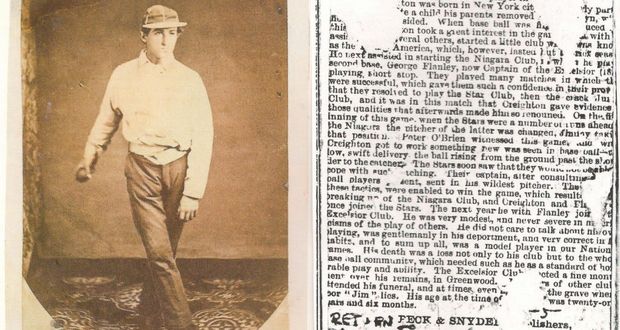
Before major league baseball existed, American pitcher Jim Creighton changed the game with fast underhand pitches and spin that other pitchers began to copy. On October 14, 1862, he collapsed with severe abdominal pain during a Brooklyn Excelsiors game and died four days later at 21 from a strangulated intestine. A teammate claimed decades later that Creighton heard something “snap” during a swing.
32. The creators of The Cabin in the Woods, which premiered in 2011, planned a downloadable level for Valve’s 2009 game Left 4 Dead 2 based on the film. MGM’s financial troubles canceled the game content and delayed the film’s wide release until 2012. Valve still let the filmmakers include infected creatures such as the Tank, Witch, and Boomer among the monsters in the film’s underground cells.
33. In 1575, long before he published Don Quixote, Spanish writer Miguel de Cervantes was sailing home from Naples when corsairs seized his ship near Barcelona. They took him to Algiers and held him for ransom, but his family could not afford his release. Cervantes made four escape attempts during nearly five years of captivity. In 1580, the Trinitarians, a religious order dedicated to ransoming captives, secured his freedom.
34. In a nationwide survey of 4,010 U.S. adults conducted in 2005, only 42% of dog owners reported walking their dog during a typical week. Those who did reported an average of 4.3 dog walks and about 129 minutes of dog walking per week.
35. In 1946, Argentina imported 20 beavers from Canada and released them in Tierra del Fuego, Patagonia, hoping to start a fur trade. The trade failed, but the beavers spread with few natural predators, and one recent estimate put their population above 100,000. They felled trees and built dams that flooded forests, roads, and pastures. Researchers have described the damage as “the largest landscape-level alteration in subantarctic forests since the last ice age.”
36 Jikji’s Metal Type Predated Gutenberg

In 1377, more than 70 years before German printer Johannes Gutenberg produced his Bible, Korean printers used movable metal type to print Jikji at Heungdeok Temple in Cheongju. Students of Buddhist monk Baegun produced the two-volume collection of teachings. Only the second volume of the metal-printed edition survives, making Jikji the oldest surviving book printed with movable metal type. The National Library of France holds that volume in Paris.
37. Thomas Edison created a written test for job applicants because he wanted employees who could recall facts and make quick business decisions. His son Theodore, a gifted MIT student, failed it. After an applicant leaked the questions, The New York Times published them with the answers, and physicist Albert Einstein took the test and failed too. The leak forced Edison to change the test more than once.
38. On May 1, 2023, a plane crashed in Colombia’s Amazon rainforest, leaving four Mucutuy siblings, aged 11 months to 13 years, without the adults who had traveled with them. The children ate flour from the plane and foraged for seeds, roots, and edible plants. After 40 days in the jungle, Colombian soldiers found Lesly, Tien, Soleiny, and Cristin alive about three miles from the wreckage.
39. In 2005, when Marvel Studios began developing Iron Man (2008) as its first independent feature, about 30 writers turned down the project, according to associate producer Jeremy Latcham. The character’s relative obscurity and Marvel’s decision to produce the film itself deterred them. Even after Marvel secured a script, many writers refused requests to rewrite it. Director Jon Favreau eventually combined drafts from two writing teams.
40. In 2008, Konami found counterfeit Yu-Gi-Oh! cards in stores and traced them through a subdistributor to Upper Deck, its authorized distributor. Upper Deck initially denied the allegation but later admitted printing hundreds of thousands of unauthorized cards in China and importing them to the United States. Konami moved to take over distribution, and a federal judge ruled against Upper Deck in 2009. The companies settled in 2010, permanently barring Upper Deck from presenting itself as an authorized distributor.
41 Achilles Bled In Homer’s Iliad

In Homer’s Iliad, the warrior Asteropaios grazed Achilles’s elbow with a spear beside the River Scamander and drew blood. Homer did not describe Achilles as invulnerable everywhere except his heel. The earliest surviving account of his mother dipping him in the River Styx appears in Roman poet Statius’s unfinished Achilleid from the first century AD. In that version, she held Achilles by one heel and left it vulnerable.
42. While playing for the New England Patriots, NFL offensive lineman Rich Ohrnberger woke up late for a team meeting and feared coach Bill Belichick would cut him. He later said he deliberately rear-ended a church van on the way to the stadium so he could blame the crash for his lateness. The elderly driver tried to apologize to him, but offensive line coach Dante Scarnecchia saw through the excuse and told Ohrnberger to be on time. Ohrnberger went on to play three seasons with the Patriots.
43. When actor Giancarlo Esposito was offered the role of Gus Fring on Breaking Bad, he had never watched the show and hesitated because the part was only a guest spot. Creator Vince Gilligan won him over by describing Gus as a man “hiding in plain sight,” a respected businessman concealing a drug operation. Esposito took the role and later developed Gus’s calm, meticulous manner around that idea.
44. In 1977, high school student Jeffrey Dahmer, who later became a serial killer, bet his classmates on a trip to Washington, D.C., that he could arrange an unannounced White House tour. Using a pay phone and presenting himself as a reporter for his school newspaper, he persuaded officials to admit the class. Their impromptu tour included the office of Vice President Walter Mondale.
45. In 1978, a Finnish man named Aarno Lamminparras asked to visit the cockpit of a domestic Finnair flight from Oulu to Helsinki, then held the pilot at gunpoint. Over a 17-hour, 4,500-kilometer journey through Helsinki, Oulu, and Amsterdam, he collected more than $200,000 in ransom. His final demands were four bottles of whisky, a chauffeured limousine, and 24 hours alone at home with his wife. He released the remaining crew, but police arrested him at home the next day.
15 Most Controversial & Costly Blunders in History
46 Ksar Draa’s Builders Remain Unknown

Near Timimoun in Algeria, the three-level, castle-like Ksar Draa rises from the Sahara’s sand dunes. Two circular walls surround rooms, communal kitchens, and a mosque, while a single entrance leads inside. Its isolated setting and defensive walls have prompted several theories about its purpose, but no one has established who built it or precisely when.
47. When Evan Almighty premiered in 2007, it was the most expensive comedy film produced until then, with production and marketing costs estimated at around $200 million. Its production budget alone reached $175 million as sets, visual effects, and filming with animals drove up costs. The film grossed about $174 million worldwide.
48. Yugoslav president Josip Broz Tito used to follow a custom of Serbian kings by visiting parents after the birth of their ninth child, congratulating them, and giving them money. He also became the child’s godfather, though he initially applied that tradition only to ninth sons. After critics called the practice sexist, Tito extended it to daughters.
49. On October 30, 1961, the Soviet Union detonated Tsar Bomba over Novaya Zemlya in the largest human-made explosion ever recorded. Its designers replaced a planned uranium tamper with lead to prevent additional fission and reduce radioactive fallout. The change cut the bomb’s potential yield from about 100 megatons to 50 megatons. Fusion supplied roughly 97% of the blast’s energy, leaving the test with unusually low fallout relative to its size.
50. In 2026, copper smelters worldwide agreed to a smelting charge of $0 per tonne, the lowest on record. Spot charges had remained negative since 2024, effectively making smelters pay mines for the right to process their concentrate. The International Energy Agency linked the squeeze to tight concentrate supplies and rapid growth in China’s smelting capacity. As their fee income disappeared, smelters relied increasingly on sales of by-products.


