


The Arctic stretches far beyond a landscape of ice and polar bears. Across this frozen frontier, ancient mammoths survived alongside early civilizations, Inuit communities forged tools from meteorites, secret military missions unfolded on drifting ice, and scientists uncovered remarkable forms of life. These 50 Arctic facts explore the region’s extraordinary history, wildlife, people, science, and places.
1 High Arctic Relocation Stranded Inuit
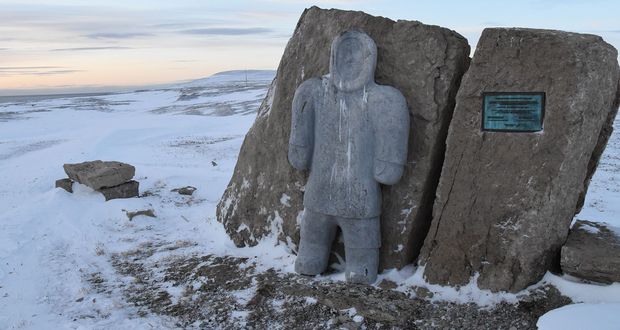
In the 1950s, the Canadian government transported 92 Inuit to the High Arctic in what is widely regarded as an attempt to assert Canadian sovereignty over the Arctic Archipelago. Beginning in August 1953, officials moved families from Inukjuak in northern Quebec roughly 2,000 kilometers to Resolute and Grise Fiord after promising better living and hunting conditions. Instead, they left the Inuit in an unfamiliar ecosystem without enough food, caribou skins, or materials for proper clothing and tents. The government also broke its promise to return them after two years, and Canada did not formally apologize for the relocation until 2010.
2. In 2007, Russia planted its national flag on the Arctic seabed in hopes of strengthening its claim to the region’s potential natural resources. On August 2, two Russian mini-submarines descended more than 4 kilometers beneath the North Pole and installed a rustproof titanium flag on the ocean floor. Canadian Foreign Minister Peter MacKay rejected the gesture, saying, “This isn’t the 15th century. You can’t go around the world and just plant flags and say, ‘We’re claiming this territory.'”
3. In 2014, a woman named Chantal Abergel and a man named Jean-Michel Claverie, both scientists at Aix-Marseille University, discovered Pithovirus sibericum inside 30,000-year-old Siberian permafrost. They exposed a sample collected 30 meters below the surface to amoebas, and the ancient giant virus remained infectious, replicated inside the cells, and killed them. The virus cannot infect humans, but its survival raised concerns that melting permafrost or tundra drilling could uncover other unknown viruses capable of causing disease.
4. The names “Arctic” and “Antarctic” can effectively be translated as “bear” and “opposite the bear,” but their origins lie in the sky rather than the regions’ wildlife. “Arctic” comes from the Greek word arktos, meaning “bear,” through arktikos, meaning “of the bear” or “of the north,” and it refers to the constellation Ursa Major in the northern sky. Antarctic combines ant-, meaning “opposite,” with arktikos, so it means “opposite the Arctic” rather than literally “without bears.” By coincidence, the distinction also fits the animals: polar bears live in the Arctic, while no bears are native to Antarctica.
5. The Soviet Union built a chain of remote lighthouses and navigation beacons along its Arctic and Far Eastern coasts, powering them with small nuclear generators. By the late 1980s, it had deployed 1,007 radioisotope thermoelectric generators, which converted heat from radioactive decay into electricity and kept the lights operating without crews. After the Soviet Union collapsed in 1991, many stations fell into disrepair, and several generators went missing or remained unaccounted for.
6 Arctic Houses Four Million Residents

About 4 million people live north of the Arctic Circle, but no one lives permanently south of the Antarctic Circle. The southern circle encloses most of Antarctica and lies much farther from inhabited areas, making it difficult and expensive to reach. Research stations operate below the line, but their scientists and support personnel stay only temporarily.
7. Around 325 BC, Greek geographer, explorer, and astronomer Pytheas sailed from Massalia, modern Marseille, becoming the first documented Mediterranean mariner to reach Britain and the first known Greek scientific visitor to describe the Arctic. His work contained the first known written use of “Britain” and the first written reference to Scotland, whose northern tip he called “Orcas,” the source of the name Orkney. His original account, On the Ocean, disappeared, and later geographers, including Polybius and Strabo, accused him of inventing his remarkable northern journey.
8. In 1896, a Swedish engineer and balloonist named Salomon August Andree attempted to launch a hydrogen balloon from Danes Island, Svalbard, toward the North Pole, but persistent northerly winds forced him to cancel the flight. On July 11, 1897, he returned with a photographer named Nils Strindberg and an engineer named Knut Fraenkel aboard the Eagle, beginning a journey followed closely across Sweden. The balloon lost hydrogen rapidly and came down on pack ice after just over two days, leaving the three men to haul heavy sleds south before they died on Kvitoya that October. In 1930, exactly 33 years later, crews from two Norwegian sealing ships found their remains, diaries, and photographs, finally solving the mystery of their disappearance.
9. Scientists have regenerated a 32,000-year-old Arctic plant from fruit tissue preserved inside an Ice Age ground squirrel’s cache in northeastern Siberia. Researchers discovered the fossilized burrows in 1995, with some holding hundreds of thousands of frozen seeds and fruits. A woman named Svetlana Yashina of the Russian Academy of Sciences cultured placental tissue from an immature Silene stenophylla fruit, producing 36 flowering plants that later created viable seeds. The species was not extinct, but the ancient plants differed subtly from their modern descendants.
10. Inuit populations retained relatively darker skin at Arctic latitudes partly because their traditional diets supplied vitamin D through fatty fish instead of relying entirely on sunlight. At northern latitudes, limited ultraviolet light generally favored lighter skin because lower melanin levels help the body produce vitamin D more efficiently. Because Inuit diets already supplied the vitamin, they faced less evolutionary pressure to develop paler skin solely for vitamin D production.
11 Steller Likely Mistook Arctic Seal

On August 10, 1741, German zoologist Georg Steller reported a mysterious creature near Alaska’s Shumagin Islands in the Arctic while sailing aboard the St. Peter on Danish explorer Vitus Bering’s Great Northern Expedition. He watched the so-called sea ape for two hours, describing a furry, limbless animal with a dog-like head and shark-like tail that played with seaweed near the ship. Although one theory interprets the account as Steller subtly mocking Bering, the surviving record provides no evidence that he invented the creature. Zoologists generally conclude that Steller probably misidentified a northern fur seal, which he had never encountered before.
12. The world’s last generally accepted woolly mammoth population survived on remote Wrangel Island in the Arctic Ocean until roughly 2500 to 2000 BC, centuries after Egyptians built the Great Pyramid of Giza. When mammoths disappeared from mainland Eurasia and North America around 10,000 years ago, approximately 500 to 1,000 remained isolated on the island. This small population survived for another 6,000 years, sharing the planet with Bronze Age civilizations such as Sumer, Elam, and the Indus Valley civilization.
13. Gates of the Arctic in Alaska is the northernmost U.S. national park and covers 7,523,897 acres, more than three times Yellowstone’s 2,219,791 acres. This immense Brooks Range wilderness has no park facilities and receives surprisingly few visitors. In 2024, about 11,900 people visited Gates of the Arctic during the entire year, fewer than the roughly 13,000 visitors Yellowstone welcomed on an average day.
14. Utqiagvik, Alaska, often called the “Top of the World,” is the northernmost city in the United States and sits 330 miles north of the Arctic Circle. When the sun sets on November 18, it remains below the horizon until January 23, creating a polar night lasting about 66 days. The town does not remain completely dark throughout this period, as civil twilight lasts about six hours near the beginning and end and about three hours around the winter solstice.
15. The Kola Superdeep Borehole on Russia’s Kola Peninsula near Murmansk in the Arctic reached 40,230 feet, making it the deepest artificial point ever drilled vertically into Earth. Soviet scientists began the research project in 1970 and reached 7 kilometers, about 23,000 feet, within five years. The borehole eventually descended more than 12 kilometers despite measuring only about 9 inches across at its deepest point. It reached its record depth in 1989, and drilling ended in 1992 after temperatures climbed to 356 degrees Fahrenheit instead of the predicted 212 degrees, making further progress impractical.
16 Norilsk Mosque Built Square-Based Minaret

The Nord Kamal Mosque in Norilsk, Russia, stands roughly 300 kilometers north of the Arctic Circle and holds a Guinness record as the world’s northernmost mosque. A Tatar businessman named Mukhtad Bekmeyev began its construction in 1993, named it after his parents Nuritdin and Gaynikamal, and inaugurated it in 1998. An architect named Josef Muire designed its 30-meter minaret with a square rather than circular base to resist freezing and powerful winds. He also angled the dome against heavy snowfall, while builders placed the entire mosque on stilts.
17. By 2007, industrial nickel smelting had polluted Norilsk in Arctic Russia so severely that workers dredged city ponds to recover valuable heavy metals from the sediment. Norilsk, the world’s northernmost city with more than 100,000 residents, ranked among Earth’s most polluted cities, while its industrial complex produced an estimated 1 percent of global sulfur dioxide emissions. Pollution had left no living trees for roughly 30 miles and concentrated metals such as platinum and palladium in the topsoil so heavily that extracting them became economically feasible. Residents faced this contaminated landscape while temperatures often fell below -25 degrees Celsius (-13 degrees Fahrenheit).
18. Following the dissolution of the Soviet Union, the Russian settlement of Tiksi in the Arctic entered a rapid population decline that left many apartment blocks abandoned. Its population fell from 11,649 in 1989 to 5,063 in 2010, then dropped to 4,173 by 2021.
19. Longyearbyen sits at 78 degrees north in Norway’s Arctic Svalbard archipelago, making it the world’s second-northernmost town. The North Atlantic Current tempers its polar tundra climate by bringing mild, humid air from the south into contact with cold northern air. Due to its warming influence, it has milder winters compared to its location and well above many cities located south of it. Its average daily winter temperatures from December through February range from -11.6 to -9.2 degrees Celsius (11.1 to 15.4 degrees Fahrenheit).
20. Svalbard, a Norwegian archipelago in the High Arctic with roughly 3,000 residents, operates as the world’s only entirely visa-free zone. Anyone may live and work there indefinitely regardless of citizenship, although officials may expel people who cannot support themselves or who violate local laws. Travelers who need a visa for mainland Norway must also obtain a double-entry Schengen visa if their route passes through it.
15 Most Controversial & Costly Blunders in History
21 Longyearbyen Permafrost Prevents Conventional Burials

Despite a popular claim, dying is not actually illegal in Longyearbyen, an Arctic town on Norway’s Svalbard archipelago. The town stopped conventional burials in 1950 after officials discovered that permafrost had prevented residents who died during the 1918 flu pandemic from decomposing. Officials typically require terminally ill residents to move to mainland Norway, while families may bury cremated remains in Longyearbyen with government permission.
22. On Svalbard, a Norwegian archipelago in the High Arctic where people live alongside polar bears, anyone traveling outside a settlement must carry suitable equipment for scaring bears away. The Governor of Svalbard also recommends carrying a firearm, but the requirement covers deterrent equipment rather than a gun specifically. Inside Longyearbyen, residents must keep transported firearms visibly unloaded and cannot take them into shops or public buildings.
23. The University of Tromso, officially UiT The Arctic University of Norway is the world’s northernmost university. Norway’s parliament established it in 1968, and it opened in 1972 before expanding across northern Norway. It had 3,776 staff in 2021 and 16,204 students in 2024.
24. Vorkuta is one of Russia’s fastest-dying cities, although it technically ranks fourth among settlements north of the Arctic Circle. Since the 1990s, industrial decline and exhausted coal mines have driven residents away, leaving some apartment complexes with only one or two families. By 2020, unofficial estimates placed its population below 50,000. Its Nenets-derived name means “abounding in bears.” It is infamous for the 1953 Vorkuta prisoner uprising that Soviet authorities brutally crushed. Call of Duty: Black Ops later fictionalized the uprising.
25. In 1943, Nazi Germany’s Kriegsmarine began operating Schatzgraber, a secret World War II weather station on Alexandra Land in the Arctic Franz Josef Land archipelago. On May 30, 1944, a weather inspector named Gerhard Wallik and a soldier named Werner Blankenburg killed a polar bear, which Blankenburg served raw as steak tartare. Within a month, ten crew members developed parasitic disease trichinosis, while a vegetarian paramedic named Gerhard Hoffmann remained the only person unaffected. On July 11, a Condor aircraft carried the entire troop to Trondheim, ending the mission.


