


51Dark Matter
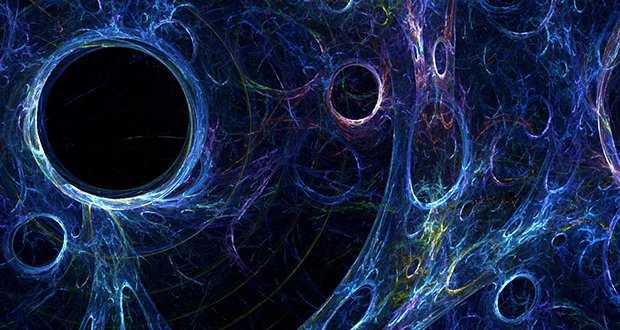
Dark matter could warm certain planets in the place of a sun, allowing life to arise on a sunless planet.
52. The tallest possible mountains on a neutron star can only be about 5mm tall due to their gravity.
53. The elusive "Dark Matter" in the universe could be detected by looking for time glitches in the existing network of GPS satellites. One researcher is already mining 15 years' worth of GPS timing data for its signature.
54. If a marshmallow were dropped a foot above the surface of a neutron star it would have the same energy of a modern atomic bomb.
55. If you had a baseball-sized piece of neutron star material it would weigh 20 trillion kg, about 40 times the estimated weight of the entire human population
Latest FactRepublic Video:
15 Most Controversial & Costly Blunders in History
56Google
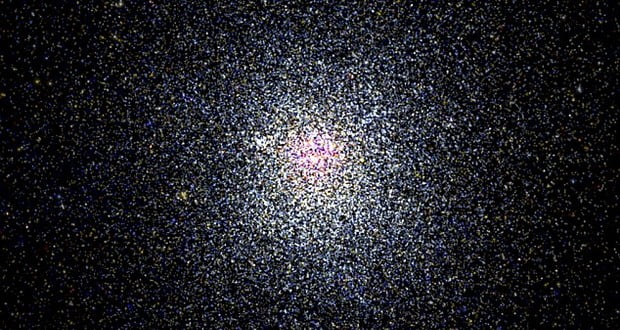
Google made a detailed, interactive map of the galaxy in HTML5, just to see if they could.
57. An international team of astronomers has spotted the farthest known gravitational lens and, as Albert Einstein predicted, it is a galaxy that deflects and intensifies the light of a much further object.
58. The Galaxy M100 is so far away that if beings from there were to look at Earth right now, they would be watching the real-time extinction of the dinosaurs.
59. Anyone with internet access can help scientists classify the shape of galaxies imaged by Hubble in a citizen scientist project.
60. Harlow Shapley, the man who discovered where our sun is in relation to our galaxy, picked astronomy to study as his major because it was the first one he saw in the course catalog.
61LEDA 074886
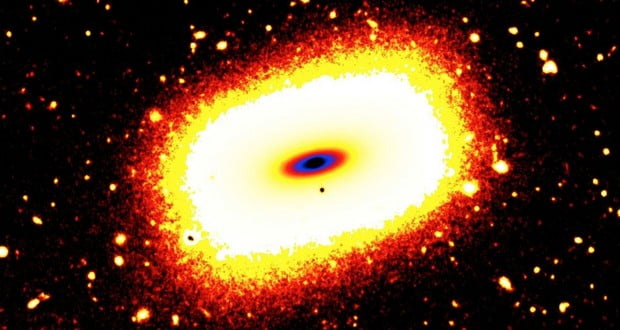
There is a galaxy called LEDA 074886 that has a rectangular shape.
62. There are ring galaxies, called Hoag's Objects, where young hot stars form a nearly perfect circle around a spherical core of old cooler stars.
63. If the largest star in the Galaxy was placed at the center of our Solar System, its surface would extend beyond the orbit of Jupiter.
64. Scientists recently discovered that some of the most powerful "Space Winds" in the universe, blowing at 125 million mph from black holes could be killing galaxies.
65. Astronomers have discovered 18 giant blue stars being ejected out of our galaxy and scientists are unsure how the stars are being propelled.
66WR 104

When the binary star system WR 104 goes supernova, within a couple thousand years, it could possibly hit Earth with a gamma ray burst, causing a mass extinction.
67. Gamma-Ray bursts could possibly be the cause behind the Ordovician–Silurian extinction event, an event that left all life on Earth restricted to the oceans.
68. Gamma-Ray bursts were discovered by satellites which were intended to monitor Earth for unauthorized nuclear bomb tests in the 1960s.
69. There is a planet that rains molten glass. It is part of a category of planets called Hot Jupiters, which are gas giants that orbit close to their star.
70. Once Iron begins to form in the heart of a giant star it only has seconds to live before it explodes into a supernova and most of the heavier elements such as Gold and Silver are formed in the resulting explosion.
71Triton
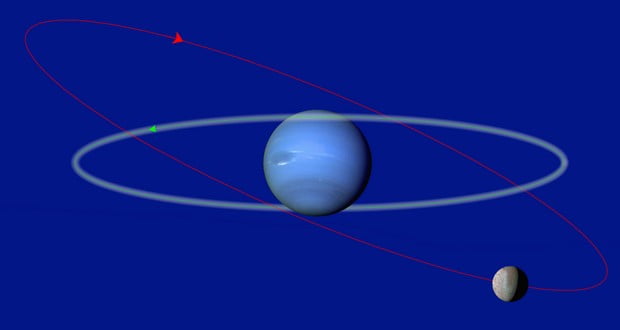
Triton, the largest moon of Neptune, is the only moon in our solar system with a retrograde orbit an orbit in the opposite direction its planet and is thus thought to be a dwarf planet that Neptune caught from the Kuiper belt.
72. Our galaxy is part the Local Group, spanning roughly 10 million light years in diameter, making up 100 billionths of a percent of the observable universe. Humanity can never venture beyond this, because of the universe's rapid expansion. Eventually, other groups may be entirely undetectable.
73. The Tarantula Nebula, a region in the Large Magellanic Cloud over 160,000 light years distant, contains the most luminous known star. The nebula’s luminosity is so great that if it were as close to Earth as the Orion Nebula, the Tarantula Nebula would cast shadows on the ground.
74. Venus flytraps were believed to be an alien species because they seemed to grow in places where meteorites were found. It was thought they had been brought to Earth by meteors.
75. There has only been one confirmed case of a person being hit by a meteor. Ann Hodges was napping on the couch when the rock broke through her ceiling, bounced off her radio and bruised her upper thigh.
