


Nuclear weapons have shaped modern history through scientific breakthroughs, secret programs, devastating tests, and unusual experiments. These 50 facts explore everything from Trinity and Tsar Bomba to missing warheads, radioactive fallout, and Cold War plans that sound almost impossible.
1 Pascal-B Cap’s Unconfirmed Speed Record
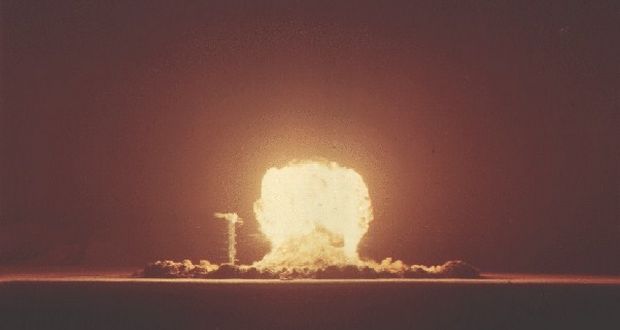
During the underground Pascal-B nuclear test at the Nevada Test Site on August 27, 1957, a nuclear detonation launched an iron cap that may hold the unconfirmed record for the fastest-moving human-made object. Astrophysicist Robert Brownlee aimed a high-speed camera at the cap, but it caught only part of the object in one frame as it flew upward. Brownlee used that image to calculate a speed of roughly 125,000 miles per hour, or five times Earth’s escape velocity. Searchers never found the cap, leaving both its fate and the record unconfirmed.
2. In 1966, after Soviet authorities spent three years trying and failing to extinguish a gas-well fire at Urta-Bulak in Uzbekistan, they decided to use a 30-kiloton nuclear device. Engineers placed it about 1,500 meters underground and detonated it beside the well. The blast crushed the well shut and extinguished the flames within seconds. After the operation succeeded, Soviet authorities used the same technique on four other well fires.
3. The Manhattan Project kept its purpose so secret that many workers had no idea what their jobs accomplished. At Oak Ridge, one laundry worker spent each day holding freshly washed and ironed uniforms against a special instrument and sending them back for another wash whenever it clicked. She learned only after the war that the instrument was a Geiger counter checking the uniforms for radioactive contamination.
4. In the 1950s, Martu elder Nyarri Nyarri Morgan witnessed a British atomic bomb test in the Australian Outback without knowing what he had seen. The blast killed nearby kangaroos, and Morgan believed a spirit had left the animals as a gift of easy hunting. He and his companions ate the kangaroos, after which people became sick. Morgan also recalled that people closer to the test did not live long and that many died.
5. In the 1950s, the British military considered sealing live chickens inside Blue Peacock nuclear landmines with enough food and water to last about a week. The Army planned to bury the 10-kiloton mines in Germany and detonate them if Soviet forces invaded from the east. Because winter cold could disable their mechanisms, designers proposed using the chickens’ body heat to keep the components warm. Britain ordered 10 mines in 1957, but the Ministry of Defence cancelled the project in 1958 over the fallout risks and political consequences of contaminating allied territory.
6 Operation Merlin’s Nuclear Blueprint Blunder

In 2000, the CIA launched Operation Merlin to delay Iran’s suspected nuclear weapons program by giving it flawed blueprints for a key bomb component. The agency used a former Soviet nuclear scientist to deliver the material. The scientist spotted the planted errors and included proposed corrections when he passed the plans to Iran. The operation may therefore have aided the program it sought to disrupt.
7. As of 2021, the U.S. military had lost six nuclear weapons in accidents and never recovered them, with the oldest missing for 71 years. That first loss occurred in 1950, when engine trouble struck an Air Force B-36 during a mock nuclear strike flight from Alaska to Texas. To avoid crashing with the weapon aboard, the crew dropped its 30-kiloton Mark 4 bomb into the Pacific Ocean. Officials said the bomb lacked the plutonium core required for a nuclear detonation, but it still contained uranium, and searchers never found it.
8. In 1942, Hungarian-American physicist Edward Teller warned his Manhattan Project colleagues that an atomic blast might ignite Earth’s atmosphere and oceans. He feared the extreme heat could fuse hydrogen into helium, trigger a runaway reaction, and turn Earth into a miniature star that destroyed all life. Physicist Hans Bethe rejected the idea, but Nobel Prize-winning physicist Arthur Compton believed the project should stop if any real danger existed. Six months before the Trinity test, Teller and physicist Emil Konopinski calculated that energy losses would prevent a self-sustaining reaction.
9. In 1973, the Nixon administration fired nuclear physicist and Manhattan Project veteran Alvin Weinberg after he repeatedly advocated greater reactor safety and molten-salt reactors. His Oak Ridge team had operated the Molten-Salt Reactor Experiment, a fluid-fuel design that became the first reactor to use thorium irradiated to produce uranium-233. Because the fuel already existed in molten form, the design avoided the conventional core-meltdown scenario. The administration favored its Liquid Metal Fast Breeder Reactor program instead, and Weinberg’s removal effectively halted further molten-salt reactor development.
10. On July 16, 1945, the United States detonated the first atomic bomb during the Trinity test in New Mexico. Dozens of miles away, a woman named Elizabeth Ingram was traveling by car toward Albuquerque when a tremendous flash filled the sky. Her sister sensed the light and asked, “What happened?” even though she was blind.
11 Starfish Prime Crippled Orbiting Satellites

In 1962, the United States detonated the 1.4-megaton Starfish Prime warhead 250 miles above the Pacific, making it the largest nuclear test conducted in space. Its unexpectedly powerful electromagnetic pulse reached Hawaii, 900 miles away, knocking out about 300 streetlights, setting off burglar alarms, and damaging a microwave telephone link. The explosion trapped roughly 10^29 electrons inside Earth’s magnetosphere, creating artificial radiation belts that damaged solar arrays and electronics and caused six or more satellites to fail over the following months. Scientists still detected some of the test’s electrons in space five years later.
12. In September 1940, Belgian mining engineer Edgar Sengier secretly shipped about 1,050 tons of exceptionally rich uranium ore from the Belgian Congo to New York, creating a Staten Island stockpile that later totaled roughly 1,200 tons. After General Leslie Groves ordered Lieutenant Colonel Kenneth Nichols to locate uranium, Nichols visited Sengier’s office in September 1942. When Nichols asked whether Union Miniere could supply the ore, Sengier replied, “You can have the ore now. It is in New York, a thousand tons of it. I was waiting for your visit.” The Army immediately acquired the stockpile, giving the Manhattan Project material needed for its uranium-separation plants and plutonium reactors.
13. In 1969, scientists detonated a 40-kiloton nuclear device more than 8,000 feet beneath Colorado’s Piceance Basin in an attempt to free trapped natural gas. The Project Rulison blast fractured the underground rock as planned and initially appeared successful without releasing radiation into the air. Between 1970 and 1971, Austral Oil tested and burned some of the released gas, but samples contained small amounts of radioactivity, prompting the company to stop flaring it and destroying its commercial prospects. By 2019, repeated monitoring had found no radioactivity in surrounding water or soil, while conventional wells had begun extracting gas from the larger field.
14. In 1945, the United States conducted the world’s first nuclear explosion during the Trinity test near Alamogordo, New Mexico. The blast’s heat fused desert soil into thin sheets of grayish-green, glass-like material that became known as trinitite. By the early 1950s, the government had excavated and buried almost all the trinitite remaining at the site and prohibited further removal. Surviving pieces remain measurably radioactive.
15. In 1952, the U.S. Air Force sent four pilots in modified F-84 Thunderjets into the mushroom cloud created by Ivy Mike, the world’s first thermonuclear device. The jets carried filters in place of their wing fuel tanks to collect radioactive debris for scientific analysis. Severe turbulence threw Air Force Captain Jimmy Robinson’s plane into an uncontrolled spin, and although he recovered, the bomb’s electromagnetic effects scrambled his electronics and prevented him from finding the refueling beacon. After running out of fuel, Robinson attempted an ocean landing, but a wave flipped his jet, and searchers never recovered the 28-year-old pilot.
16 Castle Bravo Tripled Expected Yield

Fusion on Earth requires temperatures above 100 million degrees Celsius, far hotter than the Sun’s core, and a hydrogen bomb uses an atomic fission stage to create those conditions. Unlike the earlier Ivy Mike device, which required cryogenic liquid deuterium, Castle Bravo used easily stored solid lithium deuteride. Neutrons from the fission explosion converted lithium-6 into tritium, supplying another hydrogen isotope for fusion. When the United States tested Castle Bravo in 1954, it produced 15 megatons, nearly three times its predicted yield and the largest yield of any U.S. nuclear test.
17. Caesium-137 does not occur naturally and entered the environment through nuclear fallout, making it useful for authenticating old wine. Scientists can detect tiny traces with gamma-ray instruments, sometimes without opening the bottle. If wine marketed as a 19th-century or early 20th-century vintage contains caesium-137, it must have absorbed fallout produced after nuclear testing began, exposing the wine as counterfeit or adulterated.
18. On October 30, 1961, the Soviet Union detonated the 50-megaton Tsar Bomba over Novaya Zemlya, producing the most powerful human-made explosion ever recorded. Its yield equaled roughly 3,800 Hiroshima bombs, while its mushroom cloud climbed 37 to 40 miles, about seven times Mount Everest’s height, and spread 59 miles across its top. Engineers suspended the bomb beneath an 1,800-pound parachute, giving the release and observation aircraft time to fly approximately 28 miles away despite an estimated 50 percent chance of survival. The shock wave knocked the release aircraft down by roughly half a mile, but its crew recovered and returned safely.
19. Before the United States dropped Little Boy on Hiroshima in 1945, Manhattan Project scientists never field-tested its uranium-235 gun-type design. They trusted the relatively simple mechanism. A full test would also have consumed the only U-235 available for one complete bomb, so the United States detonated it at full scale for the first time over Hiroshima.
20. In 1958, the U.S. Air Force developed Project A119, a top-secret plan to detonate a nuclear weapon on or near the Moon after the Soviet Union gained an early lead in the Space Race. Planners hoped the explosion would produce scientific data while its flash demonstrated American technological power to people watching from Earth. The Air Force canceled the project because it feared a hostile public reaction and believed a Moon landing would prove more popular.
15 Most Controversial & Costly Blunders in History
21 Hiroshima Revealed America’s Atomic Secret

The American public still did not know that the United States possessed an atomic bomb when Little Boy destroyed Hiroshima. Sixteen hours after the attack, the White House released a prepared statement from President Harry S. Truman announcing that an atomic bomb had struck the city.
22. Between 1940 and 1942, Russian physicist and Soviet Air Force officer Georgy Flyorov noticed that German, British, and American scientists had stopped publishing papers on nuclear science. He correctly concluded that these countries had moved their research into secret programs and sent two classified letters to Soviet leader Joseph Stalin in April 1942, urging him to build a uranium bomb. Stalin authorized an atomic bomb project and placed nuclear physicist Igor Kurchatov in charge of Laboratory No. 2 near Moscow.
23. In 1954, filmmakers shot the 1956 film The Conqueror near St. George, Utah, 137 miles downwind of the Nevada Test Site, where the United States had conducted 11 above-ground nuclear tests in 1953. By 1980, 91 of the 220 crew members had developed cancer, and the disease had killed 46 of them, including actor John Wayne. The figures led many people to blame nuclear fallout.
24. In 1957, five U.S. Air Force officers and one cameraman stood at ground zero about 65 miles northwest of Las Vegas while an F-89 jet fired a nuclear-tipped missile overhead. The 2-kiloton warhead detonated 18,500 feet above them, and one officer watched the explosion through sunglasses. The Air Force filmed the event to demonstrate the relative safety of low-yield nuclear explosions; the five officers volunteered, but a cameraman named George Yoshitake did not.
25. In June 1947, University of Washington biologists returned to Bikini Atoll almost a year after the United States detonated the Able and Baker atomic bombs and collected a wrasse from the lagoon. They held it up to photograph paper and took an x-ray image using radiation coming from inside the fish. The image showed that Bikini’s marine life had absorbed radioactive products instead of the Pacific Ocean simply diluting and dispersing them.


