

26 Mercury’s Comet Tail

The planet Mercury possesses a tail, similar to a comet, created by sodium atoms blasted off its surface and atmosphere by solar winds.
27. It took approximately 10 orbits around the galaxy for our planet to witness the emergence of multicellular organisms after life first appeared on Earth.
28. The outer halos of the Andromeda Galaxy and the Milky Way are already in contact with each other. The galactic collision between them has already begun its early phase.
29. The Zoo Hypothesis suggests that extraterrestrial beings are aware of our existence but intentionally avoid contact with us. This hypothesis provides a plausible solution to the Fermi Paradox, which asks, “Where is everybody?” given the estimated number of potentially habitable places in the universe.
30. Earth is the only known location in our solar system where fire can occur, as no other known exoplanets have sufficient oxygen levels to sustain fire.
31 Sun’s Proposed Inhabitants

Esteemed astronomer William Herschel presented his belief about the existence of inhabitants on the sun to Britain’s Royal Society in 1795. During that time, many scientists believed that all planets were inhabited, and some even considered the Sun to be a planet.
32. There is a cliff on Miranda, a moon of Uranus, named Verona Rupes, which is estimated to be 20 km high. It is the tallest known cliff in the solar system. If one were to jump off it, they would fall for about 12 minutes before reaching the ground due to the lower gravity.
33. In our solar system, there is a dwarf planet called Haumea, which has an egg-like shape. This peculiar shape is a result of its incredibly fast rotation. Additionally, Haumea has two moons.
34. Our moon is considered to be one of the least reflective objects in the solar system. If Neptune’s moon Triton were in the moon’s place, it would appear seven times brighter from Earth.
35. In 1993, it was observed that a comet discovered the previous year was on a collision course with Jupiter in 1994. The impact created a fireball ten times the size of our planet.
36 Bizarre Wanderer: The Rogue Planet
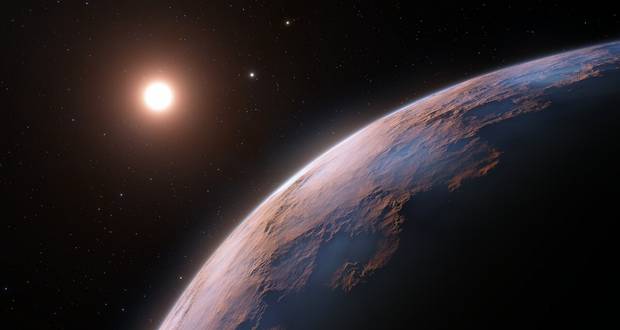
Astronomers have discovered a peculiar rogue planet wandering the Milky Way. This free-floating planet, nearly 13 times the mass of Jupiter, does not orbit a star. It exhibits stunningly bright auroras generated by a magnetic field four million times stronger than Earth’s.
37. Planets orbiting two stars, similar to Star Wars’ Tatooine, were once considered impossible by wide consensus. However, the first such planet was confirmed as recently as 2011.
38. Due to its slow rotation on its own axis and its uneven orbital path around the Sun, Mercury occasionally experiences the illusion of the Sun reversing its path in the sky, resulting in periods of double sunrises.
39. Our solar system, Sol (where Earth is located), resides inside a nebula known as the “Local Interstellar Cloud” or “Local Fluff.” As the solar system moves through this cloud, it demonstrates that one never occupies the same cosmic position more than once on a cosmic scale.
40. The International Space Station experiences weightlessness because it is in constant orbit, continuously falling around the Earth. The absence of gravity is not solely due to its distance from the Earth. If an airplane were at the same altitude as the ISS, under its own power, it would experience 89% of the gravity present on Earth’s surface.
41 Visible Matter Distribution
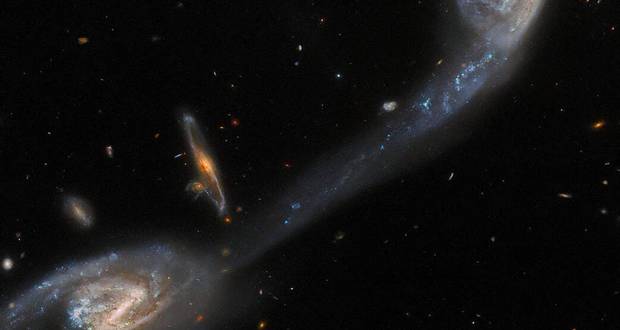
Approximately 90% of normal visible matter exists in the seemingly “empty” space between galaxies, while the remaining 10% exists within galaxies, stars, planets, and other celestial objects.
42. The Hercules-Corona Borealis Great Wall is the largest known structure in the observable universe. It is a colossal galactic filament, a massive cluster of galaxies gravitationally bound together, estimated to be about 10 billion light-years across.
43. Despite being only 6,000 light-years away from Earth, the star SMSS J031300.36-670839.3 is incredibly ancient, at approximately 13.8 billion years old, which is roughly the same age as the universe itself.
44. If a nebula the size of Earth existed, it would have a mass of only a few kilograms and be less dense than the vacuum created on our planet.
45. Star systems are much closer together near the center of the galaxy, with some systems being as close as 0.4 to 0.04 light-years apart.
15 Most Controversial & Costly Blunders in History
46 Reconstructing Destroyed Planets

Scientists have managed to virtually reconstruct the destroyed planetary system of the star WD 1145+017 by analyzing the debris field around it, leading to the emergence of a new field of astronomy known as “necroplanetology,” which focuses on studying destroyed planets.
47. According to a new 3D model of the Milky Way, our galaxy exhibits a warped shape resembling the popular brand of potato chip, with some astronomers describing it as shaped like a Pringle.
48. Stars have been discovered nearly halfway to the Andromeda Galaxy, which is over 1 million light-years away from us. For comparison, the thin disk of our Milky Way galaxy spans about 100,000 light-years, while Andromeda is located approximately 2.5 million light-years away.
49. An exoplanet named HD 189733b experiences glass rain due to its close proximity to its sun. The intense heat caused by this proximity results in daytime temperatures soaring as high as 1,700°F (930°C), leading to the formation of super-hot glass rain.
50. It took approximately 400,000 years after the Big Bang for the universe to cool down enough to allow the formation of atoms.


RE: Fact #13 (Solar System’s Fiery Orb) – If this is the case, how have the Voyager probes survived this intense heat? Haven’t they passed beyond the solar system’s heliosphere and are in interstellar space?