



1Australia’s Roadless Train Station

Wondabyne railway station in Australia is the only one in the country with no road access. It is a request stop primarily used by hikers and local residents who access their homes by boat.
2. The gyromonorail was an experimental railway system that ran on a single track, balancing upright using a gyroscope. Despite its ability to bank on turns, the concept was never implemented beyond the prototype stage due to the high cost of equipping each train car with a gyroscope.
3. During the Battle of Stalingrad in World War II, a local railway station changed hands between Soviet and German forces 14 times in just six hours.
4. The London Necropolis Railway opened in 1854 to transport corpses and mourners to a cemetery 37 km outside the city. The cemetery, the largest in the world at the time, even had two stations—one for Anglicans and another for non-Anglicans.
5. In 1972, artist Dieter Meier installed a commemorative plaque at the Kassel railway station in Germany, declaring, "On 23 March 1994, from 3 to 4 pm, Dieter Meier will stand on this plaque." True to his word, he fulfilled the promise 22 years later.
Latest FactRepublic Video:
15 Most Controversial & Costly Blunders in History
6Russian Stray Dogs Use Subway
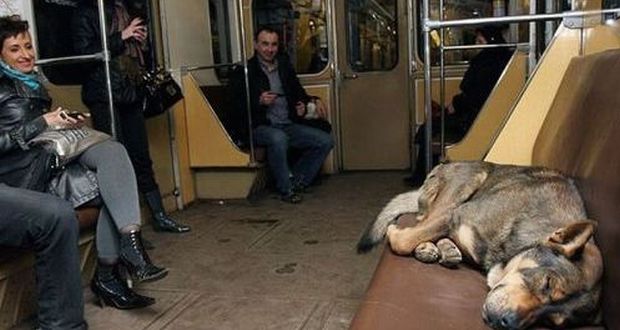
In post-Soviet Russia, feral dogs have adapted to urban life by learning to commute on the subway. They navigate the system based on station announcements, allowing them to expand their food scavenging territory.
7. In the 1950s, England built an underground city to shelter 4,000 key government employees in the event of a nuclear strike. The facility included 60 miles of roadways, an underground lake for fresh water, and a railway for transporting the royal family. The project remained secret until it was revealed to the public in 2004.
8. As the city of Wuppertal, Germany, expanded, it faced a challenge—there was no space to build a conventional railway. Instead of a standard monorail, the city constructed an innovative "Floating Monorail" system above the river. Commencing operation in 1901, it still remains in popular use a century later.
9. By 1960, rail transport in the USSR had become so dominant that it handled nearly half of the world’s railway freight (measured in tonne-kilometers), despite its rail system comprising only 10% of the world's railway length.
10. A baboon named Jack officially worked as a signalman for South African Railways from 1881 to 1890. He received a daily wage of twenty cents and half a bottle of beer each week. Remarkably, Jack never made a single mistake throughout his railway career.
11Amsterdam’s Tram 8 Never Reused

During World War II, Amsterdam’s tram line number 8 was used to deport Jews. As a result, the line was discontinued in 1942, and the number 8 has never been reassigned to a tram route since.
12. The deepest London Underground station, located 221 feet underground, was never completed. Instead, it was repurposed to store secret archives during World War II.
13. Trams in Hiroshima resumed service just three days after the atomic bomb was dropped.
14. In the United States, a "Union Station" refers to a railway station where two or more separate railway companies share tracks and facilities. This explains why many major cities have a train terminal called Union Station.
15. In 2013, a train crash in Australia occurred due to an unexpected culprit—millipedes. Swarms of them covered the tracks, causing a train pulling into a station to lose traction as it crushed the insects, ultimately resulting in a collision with another train.
161897 Ocean Tram on Stilts

Magnus Volk, a British railway pioneer, designed the "Daddy Long Legs" in 1897, a unique electric tram designed to run on submerged tracks in the ocean. Mounted on four 23-foot-tall legs, it moved at a slow walking pace, allowing passengers to travel above the waves.
17. New York City has entire fake buildings designed to function as ventilation shafts for the underground subway system.
18. The Vatican has the world’s shortest railway, consisting of just two 300-meter tracks and a single station, Città del Vaticano. Although primarily used for importing goods, it remains a symbolic relic, as no regular passenger trains operate there.
19. In 1985, First Lady Elena Ceaușescu ordered the removal of the Piața Romană metro station in Romania, believing that workers and students needed more exercise. However, engineers secretly built the station anyway, recognizing its importance to the metro system.
20. The Montparnasse derailment in Paris remains one of the most infamous train accidents in history. A speeding train entered the station too fast, crashed through a wall, and plummeted 33 feet before landing on its nose, tragically killing a woman standing below. A guard, distracted by paperwork, failed to apply the emergency handbrake and was fined 25 francs for his negligence.
21Japan’s Deepest Station: 486 Steps

Japan’s deepest train station sits 70 meters (230 feet) underground. With no escalators, passengers must descend 486 steps, taking about 10 minutes to reach the platform from the ticket gate.
22. From 1927 to 2003, the UK Royal Mail operated an underground railway network in London, using driverless trains to transport mail between sorting offices.
23. The film Trainspotting got its name from Leith Central Railway Station in Scotland, which, in the 1980s, became a gathering place for drug addicts who were mockingly said to be "train-spotting."
24. The Tremont Street Subway in Boston is the oldest underground rail system in North America and the third oldest in the world, following London and Budapest.
25. The London Underground, once marketed as a cool refuge from hot weather, has been gradually heating up. This is due to dissipated heat from train braking, which the surrounding clay—a natural insulator—traps and retains over time.
