


1Ganymede
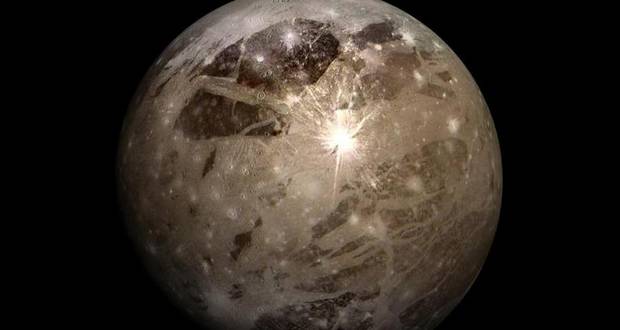
Jupiter's moon Ganymede has a thin oxygen atmosphere and also likely has a saltwater ocean 200 km below the surface.
2. Saturn’s moon Mimas is the smallest known astronomical body to still have a round shape due to self-gravitation. Its total surface area is approximately the same as Spain.
3. Saturn's largest ring, the Phoebe ring, is so big that if it were visible to the naked eye, it would span the width of two full moons in our sky.
4. Mars' moons, Phobos, and Deimos orbit in opposite directions along the equator. At certain longitudes, you wouldn't be able to see them at all.
5. Saturn's moon Iapetus was discovered in 2007 to have a unique equatorial ridge that has peaks up to 8 mi (13 km) high and only exists in the dark region of the moon. There is no definitive explanation for how it formed.
Latest FactRepublic Video:
15 Most Controversial & Costly Blunders in History
6A Planet Named George

The planet Uranus was originally named "George" after the British King George III.
7. Mercury's diameter is only 1/194th of that of the sun, as seen from Earth. A telescope with a magnification of 50 to 100x shows Mercury as a small black dot crossing the sun's face during a transit, which will happen again in 2032.
8. Venus could have had habitable conditions for billions of years in the past, long enough for life to have developed.
9. The atmosphere of Venus is so thick that it has 4 times more Nitrogen than Earth even though its Nitrogen only makes up 3.5% of its atmosphere, compared to 78% of Earth's atmosphere.
10. Raindrops on Saturn's largest moon, Titan (the only other known world with seasonal rainfall) would be twice as big as raindrops on Earth and would fall as slow as snowflakes. Also, they're made of liquid methane, not water.
11Uranus' Axial Tilt

Because of Uranus' axial tilt, it "rolls" around the sun like a marble. Its poles each experience 42 years of light and 42 years of darkness during the summer and winter solstices.
12. Neso, one of the moons of Neptune, is the farthest moon from its planet in the Solar System. It takes 26 Earth years to orbit Neptune planet once and it is as far away from the planet as the Earth is to Venus.
13. It is Venus, not Earth, that has the least orbital eccentricity or most circular orbit in the solar system.
14. One of Jupiter's moons, Callisto, has about 99% of the diameter of the planet Mercury, but only about a third of its mass.
15. Phobos, Mars's largest moon, is set to collide with Mars or break up into a ring in 50 million years due to tidal forces.
16Moons of Uranus

The moons of Uranus are the only moons in the universe not given Roman/Greek names, they are given names from Shakespeare's characters.
17. Rhea, a moon of Saturn, is showing signs of a breathable atmosphere and is a good canidate for an oxygen and water refill station for future missions.
18. Triton, the largest moon of Neptune, is the only moon in our solar system with a retrograde orbit - an orbit in the opposite direction of its planet and is thus thought to be a dwarf planet that Neptune caught from the Kuiper belt.
19. The co-orbital Saturn moons Epimetheus and Janus avoid collision by mutual acceleration, deceleration, and an eventual orbit "trading" every four years.
20. Uranus smells like farts because its atmosphere consists largely of hydrogen sulfide.
21Naked-Eye Planets

Five planets visible to the naked eye, Mercury, Venus, Mars, Jupiter, and Saturn, have been known since ancient times. They can easily be seen with the naked eye if one knows when and where to look.
22. All of Jupiter's moons are named after the extramarital lovers and children of the mythical Roman god Jupiter. NASA’s probe to Jupiter, Juno, was named after his wife flying in to "check up on her husband's mischief."
23. Saturn has a very well-defined hexagon at its north pole that can fit up to four piles of earth inside of it.
24. Jupiter's moon Io is surrounded by a cloud of neutral Sodium (Na) gas which changes shape in response to variations of Jupiter's magnetic field.
25. The magnetosphere of Jupiter, extends up to seven million kilometers in the Sun's direction and almost to the orbit of Saturn in the opposite direction. If it was visible from Earth, in the night sky, it would be roughly 4 to 5 times bigger than our moon.
