


26Uranus - Geometric Mess
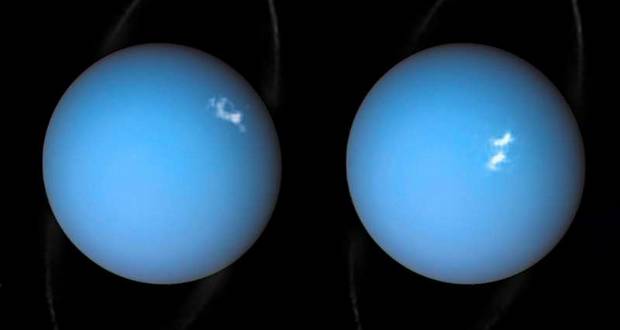
Uranus has a magnetic field that "flickers" because its magnetic field is so off-kilter with its rotational axis that magnetic lines will snap apart and reconnect as it rotates. According to one astronomer, "Uranus is a geometric mess."
27. The sky on Mars is red and its sunsets are blue, which is exactly the opposite of Earth's.
28. The orbit of Mercury follows a unique pattern different from other planets which remained unexplained until Einstein’s theory of bending space-time due to large nearby gravitation. The previous theory was there was another planet between mercury and the sun, which they named Vulcan.
29. Jupiter has a layer of liquid metallic hydrogen underneath all the layer of gasses that we see meaning that it has a huge magnetic field and very bright and large auroras at its poles.
30. Almost all pictures we see of Venus are filtered for more cloud detail, or remove all clouds completely. Viewed naturally the planet appears bright white and nearly featureless due to the complete cloud cover.
Latest FactRepublic Video:
15 Most Controversial & Costly Blunders in History
31Solar System’s Tallest Cliff

If you were to jump off the tallest cliff in the Solar System, Verona Rupes on Uranus's moon Miranda, you would fall for 12 minutes before hitting the ground a good 20 km below.
32. Jupiter's Great Red Spot is so loud, that its acoustic sound waves heat the surrounding atmosphere to almost 2400 degrees Fahrenheit.
33. The planet Mercury, the closest planet to the sun, has a nighttime temperature of -280°F as it has no atmosphere to retain the 800°F temperature it reaches during the day.
34. One major concern of establishing human settlements on Mars is pregnancy. Members of the craft may likely not engage in sex due to their stressful and isolated environment, and it is still not fully known how the environment in a spacecraft would affect the development of a child aboard.
35. The A and B rings of Saturn (the most visually prominent rings) are hundreds of thousands of kilometers wide, but only 5-15 and 10-30 meters thick, respectively.
