



1Panda Fetus In a Cat

Scientists have attempted to grow panda fetuses in a cat. It worked, but the cat's mother died of pneumonia before she completed term.
2. When newborn opossums latch onto their mother's nipple for the first time, the nipple swells, and the baby becomes stuck to it for 55 to 60 days.
3. Mother black bears do not typically attack to defend their cubs. They may show harmless bluster, which makes them seem ferocious. Defense of cubs against people is mainly seem in grizzly bears not black bears.
4. Kangaroos can pause their pregnancies for up to two years in times of hardship. They will then start it up again when conditions improve.
5. Pandas will sometimes fake pregnancies to receive more food and special treatment from humans.
Latest FactRepublic Video:
15 Most Controversial & Costly Blunders in History
6Fawn Kidnapping

Fawns (baby deer) are often left alone for hours while their mothers forage for food. Sometimes well-meaning people 'kidnap' the fawn thinking it has been abandoned when it is just waiting for its mom.
7. Female kangaroos can be perpetually pregnant. While the young joey is nursing in her pouch, another embryo will put itself "on hold" until the new baby leaves the pouch, after which the inch-long newborn kangaroo will crawl up to and into the pouch.
8. Dolphins are born with mustaches (hair around the upper lip). A mustache helps newborn dolphins locate and feel their mother for the first few days of nursing and falls off after a week or so because of a natural depilatory process.
9. Most polar bears are twins and while they are the largest land carnivore, newborn cubs are only about 10 inches (25 cm) long and weigh about 2.2 pounds (1kg). They grow rapidly because the mother's milk they feed on is 31% fat.
10. Giraffes give birth standing up, requiring the newborn to fall 6 feet to the ground.
11Cannibalism in Axolotls
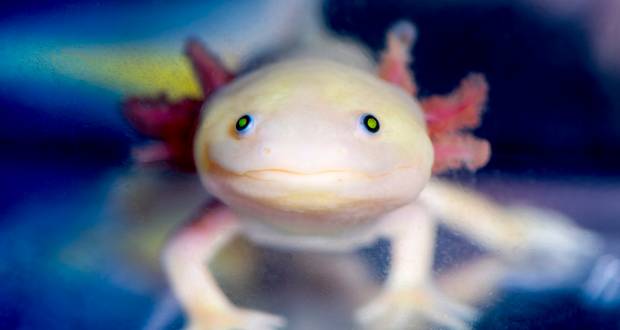
Due to the scarcity of food in their natural habitat, newborn wild Axolotls will resort to cannibalism and eat their siblings' limbs. The victims still have chances to survive though, since the Axolotl can regenerate not only limbs but major organs such as gills at any stage in its life.
12. Infanticide has been observed in dolphins, where a male dolphin will attempt to kill a newly born calf to free its mother for mating.
13. When a female blue whale gives birth to its calf, it can weigh up to 3 tons and stretch up to 25 feet, which already makes it as one of the largest creatures on earth. It can grow an impressive 200 pounds a day during its first year of life.
14. A cow can be tricked into nursing a calf not her own by skinning her dead baby and putting the skin on another calf. The practice is called "grafting".
15. In 2017, scientists made a lifelike animatronic baby langur monkey with cameras to observe real monkeys in the wild. When it was knocked down and stopped working, female monkeys grieved over the "dead" child.
16Eel Lifecycle Mystery

Biologists are still yet to confirm how baby eels are made. Much of their lifecycle remains a mystery. The general consensus is that adult eels migrate to the Sargasso Sea to spawn offspring, but only single adult eels have ever been observed in open waters. Nobody has seen two eels mate.
17. In 2011, a baby penguin was born without feathers in a Chinese zoo and was thus rejected by his parents. Its zookeepers however found out he had digestion problems, so they fed him by hand until he grew feathers and was then reunited with his parents.
18. Postpartum depression in dogs can take place straight after a dog gives birth and may stay with them for a long time without treatment.
19. A group of mongoose mothers will all give birth on the same night, as doing so in a large enough group protects their offspring from predators.
20. Adactylidium is a type of mite which is known for its unusual life cycle. The pregnant female grows 5-8 females and 1 male inside her body. The male then impregnates the females while still in the mother. The females then eat their way out of their mother, and the male dies shortly after. Four days later, their daughters do the same to them.
21Super Weaners

Elephant seals have an abrupt weaning process. Their pups however are super weaners who, in an attempt to slow their weaning, will steal milk from nursing female elephant seals, or be adopted by another nursing mother elephant seal ("double mother-sucklers"). Super weaners are usually male and they sometimes weigh as much as 600 lbs.
22. Sloth babies usually survive if they lose their grip on their mom and fall to the ground. Sometimes however the mother sloths don’t descend to the ground to pick the baby up as she’d risk being seen by predators.
23. If a camel rejects her newborn or there's a need to adopt an orphaned calf, Mongol herders use a chanting ritual accompanied by a fiddle or flute to coax her into accepting the calf. The camel mother may act aggressively initially, so the herders will change the melody depending on her behavior.
24. Matriphagy has been observed in Australian spider species Diaea Ergandro. The mother allows her babies to suckle blood from her leg joints until she has weakened and (usually) dies. This prevents early cannibalism between the spiderlings and thus resulting in more of the clutch surviving.
25. A female Giant Pacific Octopus can lay 50,000 eggs. She then quits eating and spends the next six months slowly dying as she tends to and protects them. On average, only 2 out of the 50,000 baby octopuses survive.
