

26Humans & Dinosaurs

Humans and dinosaurs (other than birds) did not coexist. The last of the non-avian dinosaurs died 66 million years ago in the course of the Cretaceous–Paleogene extinction event, whereas the earliest members of genus Homo (humans) evolved between 2.3 and 2.4 million years ago. This places a 63-million-year expanse of time between the last non-bird dinosaurs and the earliest humans. Humans did coexist with woolly mammoths and saber-toothed cats—mammals which are often depicted alongside humans and dinosaurs.
27. Marco Polo did not import pasta from China, a misconception which originated with the Macaroni Journal, published by an association of food industries with the goal of promoting the use of pasta in the United States. Marco Polo describes a food similar to "lagana" in his Travels, but he uses a term with which he was already familiar. Durum wheat, and thus pasta as it is known today, was introduced by Arabs from Libya, during their conquest of Sicily in the late 7th century, according to the newsletter of the National Macaroni Manufacturers Association, thus predating Marco Polo's travels to China by about six centuries.
28. Houseflies have an average lifespan of 20 to 30 days, not 24 hours. The misconception may arise from confusion with mayflies, which, in some species, have an adult lifespan of as little as 5 minutes. A housefly egg will hatch into a maggot within 24 hours of being laid.
29. Older elephants that are near death do not leave their herd and instinctively direct themselves toward a specific location known as an elephants' graveyard to die.
30. It is true that life expectancy in the Middle Ages and earlier was low; however, one should not infer that people usually died around the age of 30. In fact, earlier low life expectancies were very strongly influenced by high infant mortality, and the life expectancy of people who lived to adulthood was much higher. A 21-year-old man in medieval England, for example, could by one estimate expect to live to the age of 64.
Latest FactRepublic Video:
15 Most Controversial & Costly Blunders in History
31macOS

Computers running macOS or Linux are not immune to malware such as trojan horses or computer viruses. While Microsoft Windows has a much larger number of viruses developed for it, this is a consequence of its extremely large market share – specialised malware designed to attack macOS and Linux systems has existed for many years.
32. Egg balancing is possible on every day of the year, not just the vernal equinox, and there is no relationship between astronomical phenomena and the ability to balance an egg. The tradition of balancing eggs on a particular date originates in China, when it was reported on by Life magazine in 1945. However, it was reported in 1987 that Frank Ghigo was able to balance some eggs on every day from February 27 to April 3, 1984. At the same time, he also found that "...some eggs would simply never balance, on the equinox or otherwise.
33. The expression "rule of thumb" did not originate from a law allowing a man to beat his wife with a stick no thicker than his thumb, and there is no evidence that such a law ever existed. The true origin of this phrase remains uncertain, but the false etymology has been broadly reported in media including The Washington Post (1989), CNN (1993), and Time magazine (1983).
34. The daddy longlegs spider (Pholcidae) is not the most venomous spider in the world, and they can indeed pierce human skin, though the tiny amount of venom they carry causes only a mild burning sensation for a few seconds. In addition, there is also confusion regarding the use of the name daddy longlegs, because harvestmen (order Opiliones, which are arachnids, but not spiders), crane flies (which are insects), and male mosquitoes (also insects) are also sometimes called daddy longlegs in regional dialects, and may occasionally share the misconception of being venomous.
35. Napoleon Bonaparte was not short. He was actually slightly taller than the average Frenchman of his time. After his death in 1821, the French emperor's height was recorded as 5 feet 2 inches in French feet, which in English measurements is 5 feet 7 inches (1.69 m). Some believe that he was nicknamed le Petit Caporal (The Little Corporal) as a term of affection. Napoleon was often accompanied by his imperial guard, who were selected for their height —this could have contributed to a perception that he was comparatively short.
361871 Great Chicago Fire
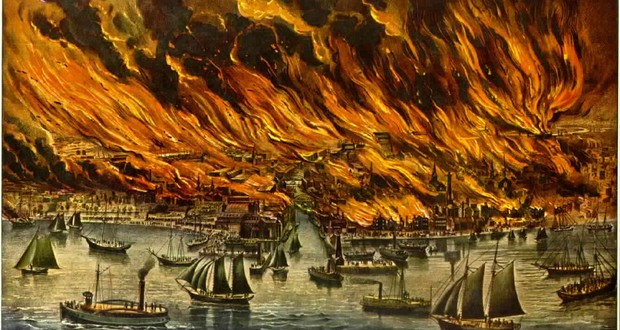
The Great Chicago Fire of 1871 was not caused by Mrs. O'Leary's cow kicking over a lantern. A newspaper reporter invented the story to make colorful copy.
37. Cinco de Mayo is not Mexico's Independence Day, but the celebration of the Mexican Army's victory over the French in the Battle of Puebla on May 5, 1862. Mexico's Declaration of Independence from Spain in 1810 is celebrated on September 16.
38. Columbus never reached any land that now forms part of the mainland United States of America; most of the landings Columbus made on his four voyages, including the initial October 12, 1492 landing (the anniversary of which forms the basis of Columbus Day), were on Caribbean islands which today are independent countries. Columbus was also not the first European to visit the Americas: at least one explorer, Leif Ericson, preceded him by reaching what is believed to be the island now known as Newfoundland, part of modern Canada, though he never made it to the mainland.
39. Actor Ronald Reagan was never seriously considered for the role of Rick Blaine in the 1942 film classic Casablanca, eventually played by Humphrey Bogart. This belief came from an early studio press release announcing the film's production that used his name to generate interest in the film. But by the time it had come out, Warner Bros. knew that Reagan was unavailable for any roles in the foreseeable future since he was no longer able to defer his entry into military service. Studio records show that producer Hal B. Wallis had always wanted Bogart for the part.
40. Immigrants' last names were not Americanized (voluntarily, mistakenly, or otherwise) upon arrival at Ellis Island. Officials there kept no records other than checking ship manifests created at the point of origin, and there was simply no paperwork which would have created such an effect, let alone any law. At the time in New York, anyone could change the spelling of their name simply by using that new spelling. These names are often referred to as an "Ellis Island Special."
41Great Wall of China

The Great Wall of China is not, as is claimed, the only human-made object visible from the Moon or from space. None of the Apollo astronauts reported seeing any specific human-made object from the Moon, and even earth-orbiting astronauts can barely see it. City lights, however, are easily visible on the night side of earth from orbit. Shuttle astronaut Jay Apt has been quoted as saying that "the Great Wall is almost invisible from only 180 miles (290 km) up." ISS commander Chris Hadfield attempted to find it from space, but said that it was "hard as it's narrow and dun-colored."
42. The widespread urban legend that one swallows a high number of spiders during sleep in one's life has no basis in reality. A sleeping person causes all kinds of noise and vibrations by breathing, the beating heart, snoring etc. all of which warn spiders of danger.
43. French queen Marie Antoinette did not say "let them eat cake" when she heard that the French peasantry were starving due to a shortage of bread. The phrase was first published in Rousseau's Confessions when Marie was only nine years old and most scholars believe that Rousseau coined it himself, or that it was said by Maria-Theresa, the wife of Louis XIV. Even Rousseau (or Maria-Theresa) did not use the exact words but actually Qu'ils mangent de la brioche, "Let them eat brioche" (a rich type of bread). Marie Antoinette was an unpopular ruler; therefore, people attribute the phrase "let them eat cake" to her, in keeping with her reputation as being hard-hearted and disconnected from her subjects.
44. The Library of Alexandria was not destroyed by the Muslim Army during the capture of the city in 641. A common misconception alleged that Caliph Umar ordered the destruction based on the reasoning "If those books are in agreement with the Quran, we have no need of them; and if these are opposed to the Quran, destroy them" (or its variation). This story did not appear in writing until hundreds of years after the alleged incident (most famously in the work of Bar Hebraeus in the 13th century) and contemporary accounts of the Arab invasion do not include any account of the library's destruction. Modern consensus suggests the library had likely already been destroyed centuries before this incident. (It is instead believed that the Library of Caesarea, a key repository of Christian literature, was the library destroyed near this time.)


