

21 Okiku Inspired The Ring Ghost

The girl from “The Ring” was inspired by a Japanese legend about a young girl named Okiku, who served a samurai named Tessan Aoyama at Himeji Castle. Aoyama hid one of ten valuable golden plates and threatened to accuse Okiku of stealing it unless she accepted his advances. After she refused, one version says Aoyama threw her into a well, while another says she jumped into it after finding no other escape. According to the legend, her ghost crawled from the well every night, counted the plates, and tormented Aoyama until he lost his mind.
22 Depression Defies Simple Serotonin Theory

The popular claim that depression simply results from low serotonin is an oversimplification that researchers have challenged for years. A 2015 paper noted that the serotonin hypothesis was nearly 50 years old but had never been clearly substantiated. Evidence suggests that impaired serotonin function can contribute in some circumstances, but it is neither necessary nor sufficient to cause depression. Although antidepressants alter serotonin activity, researchers still do not fully understand how those changes produce their therapeutic effects.
23 Taj Mahal Scaffold Vanished Overnight

During the 17th-century construction of the Taj Mahal in Agra, workers built a colossal brick scaffold that mirrored the tomb’s inner and outer surfaces. Foremen estimated that dismantling the enormous structure could take years. According to legend, Mughal emperor Shah Jahan announced that anyone could keep the bricks they removed, prompting local peasants to strip the scaffold overnight.
24 Cell Phones Cannot Ignite Gasoline

The belief that using a cell phone while fueling a car can ignite gasoline vapors and cause a fire or explosion is a common urban legend. Investigators have never documented a refueling fire caused by a cell phone anywhere in the world. Researchers have also repeatedly tried and failed to trigger one under controlled conditions, leaving no evidence that ordinary phone use can ignite fuel at the pump.
25 Library Of Alexandria Declined Gradually
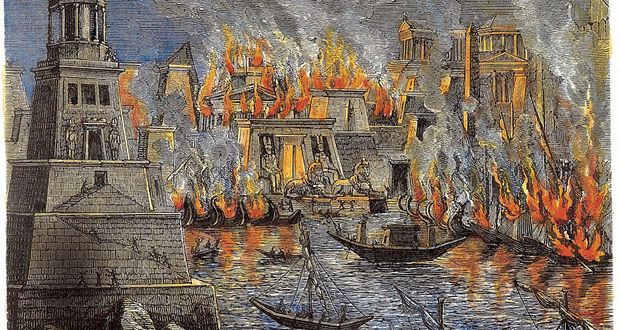
The popular story that a single fire destroyed the Library of Alexandria is largely a myth. Julius Caesar’s fire in 48 BC may have damaged part of the collection, but the institution survived or was rebuilt and continued operating afterward. The Library declined over the following centuries as funding, prestige, and scholarly membership disappeared, with the last known memberships dating to the 260s AD. Most of its material may have survived through copies held elsewhere, and historians cannot confirm whether the Serapeum still contained a library when Christians demolished it in 391 AD.
26 Disney Filmmakers Faked Lemming Suicide

Lemmings do not commit mass suicide, despite a myth popularized by Walt Disney’s 1958 documentary “White Wilderness.” To create its dramatic ending, filmmakers threw lemmings from a cliff and presented the footage as a suicidal plunge into the sea. In 1983, a Canadian Broadcasting Corporation producer named Brian Vallee also revealed that the crew staged the mass migration using careful editing, tight camera angles, and a snow-covered turntable. In reality, crowded lemmings disperse in search of food and may accidentally drown while crossing water, but they do not deliberately kill themselves.
27 Cobalt Name Came From Kobolds

Cobalt takes its name from the kobold, a trickster goblin in German folklore. Medieval German miners searching for silver tried to smelt cobalt-bearing ore, but it produced no precious metal and released toxic arsenic and sulfur fumes. The miners blamed kobolds for stealing the silver and poisoning them, turning their supernatural explanation into the element’s lasting name.
Latest FactRepublic Video:
15 Most Controversial & Costly Blunders in History
28 Aurora Sex Myth Was Alaskan

To explain why so many Japanese tourists traveled to Alaska to see the northern lights, some Alaskans circulated a baseless claim that couples had sex beneath the aurora for good luck and a gifted child. The CBS series “Northern Exposure” presented the tale as “Japanese folk wisdom” in 1992, helping it spread far beyond Alaska. A 2007 New York Times report investigated the rumor, and American screenwriter Jeff Vlaming claimed he had found it in the November 1991 issue of Alaska magazine, though investigators could not verify the item. No evidence indicates that the belief came from Japanese folklore or drove Japanese aurora tourism.
29 Popeye Praised Spinach’s Vitamin A

The story that Popeye ate spinach because a misplaced decimal point exaggerated its iron content is a myth. Although early analyses may have overstated spinach’s iron level, scientists knew the correct value before cartoonist Elzie Segar created Popeye. In a 1932 comic strip, Popeye credited spinach’s strength-building power to vitamin A, not iron.
30 Kitty Genovese Witness Myth Unravels

On March 13, 1964, a 28-year-old bartender named Kitty Genovese was murdered outside her apartment building in Kew Gardens, Queens, but the famous claim that 38 witnesses watched and ignored her attack is a myth. Two people called the police, while a woman named Sophia Farrar found Genovese after the second attack and held her until an ambulance arrived. The New York Times published its exaggerated account two weeks later, although nobody witnessed the entire attack and many neighbors misunderstood what they heard. In 2016, the newspaper acknowledged its flawed reporting, while another reporter recalled Times reporter Martin Gansberg saying that the omitted facts “would have ruined the story.”


RE: Fact #9 (Ellis Island Never Changed Names) – Many people chose to change their names. Even well into the 20th century, famous people would often switch to stage names to fit in better. Plenty of Jewish performers did this, like Stanley Lieber becoming Stan Lee, or Chaim Witz changing to Gene Simmons.