


26Fairy Corpse Hoax: April Fools' Prank

On April 1, 2007, Londoner Dan Baines staged an April Fools' prank by posting a fabricated fairy corpse on an online auction site. Claiming authenticity with elaborate details, including hollow bird-like bones and wings, Baines attracted 20,000 viewers in a day. After initial assertions, he later confessed to the hoax and added a disclaimer. Despite the admission, some believers maintain the fairy's authenticity, accusing Baines of concealment.
27. The Tasaday tribe in the Philippines, who were once labeled as a lost Stone Age society, were revealed to be a hoax. Despite claims of noble savagery, they were manipulated by Manuel Elizalde Jr., facilitating visits for anthropologists and celebrities. The ruse was exposed when Oswald Iten found them in modern clothing, using tools, during an unexpected visit. They later admitted to playing a role for financial gain. While some deemed it a publicity scam linked to the regime of Ferdinand Marcos, Filipino President Corazon Aquino declared them real in 1988, sparking ongoing scholarly debates about their authenticity.
28. David Rosenhan and seven of his colleagues conducted an experiment in 1973 to see if psychiatric professionals could correctly diagnose patients by simulating auditory hallucinations. Admitted to psychiatric facilities across five US states, the "pseudopatients" behaved normally but were often misinterpreted as mentally ill. After personnel failed to identify the fake patients in a subsequent phase, Rosenhan concluded that distinguishing between the sane and insane was challenging for professionals in psychiatric settings.
29. In 1702, con artist George Psalmanazar fabricated a fantastical tale about the fictional land of Formosa (now Taiwan), claiming to be a native. With a Scottish priest, he traveled to London, shocking the English with tales of polygamy, cannibalism, and underground living for the upper class. His 1704 book became a bestseller. However, Psalmanazar was later discredited, yet he faced no punishment and went on to become a respected theologian.
30. In 1910, Irish poet Horace de Vere Cole orchestrated a prank by convincing friends, including Virginia Woolf and Duncan Grant, to pose as an Abyssinian delegation visiting the flagship HMS Dreadnought. Faking an official telegram, Cole fooled the navy into an elaborate reception, complete with a tour and fake Swahili remarks. The media exposed the hoax on February 12, prompting the Royal Navy to send the Dreadnought to sea to escape the publicity, and the Bloomsbury Group was not formally charged to put the incident behind them.
Latest FactRepublic Video:
15 Most Controversial & Costly Blunders in History
31Alien Autopsy Hoax: Santilli's Fabrication
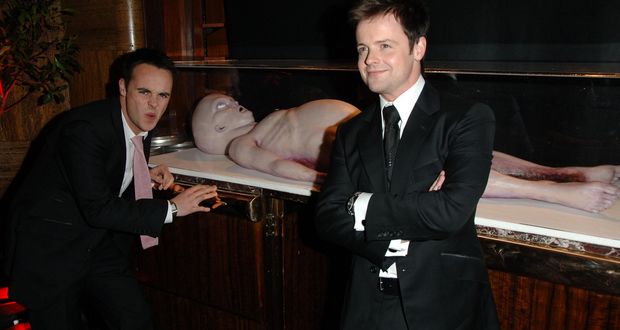
In 1995, Ray Santilli claimed to possess footage of an "alien autopsy" after the 1947 Roswell UFO incident. Initially presented as authentic, he later revealed on April 4, 2006, that only a few frames were real, and the rest was a reconstruction using dummy alien bodies and a constructed set in London. The announcement stirred controversy, with some questioning the film's authenticity.
32. Rupert Hughes, a lexicographer, included an unusual entry, ZZXJOANW, in the Music-Lovers Encyclopedia, claiming it was a Maori word pronounced 'Shaw,' meaning 'Drum' or 'Fife.' Despite staying in the encyclopedia for 70 years, it was later realized that Maori lacks Z and X, and words end with a vowel. The entry, now acknowledged as a hoax, has sparked theories about the possibility that Hughes encoded a message, such as sending kisses to someone named Joan Shaw.
33. In the mid-1950s, late-night DJ and writer of "A Christmas Story," Jean Shepherd, orchestrated a memorable prank after a bookstore clerk denied the existence of a book because it wasn't on the best sellers list. Outraged by this criterion, Shepherd fabricated a scandalous novel titled "I, Libertine" and encouraged listeners to request it at bookstores, confounding clerks and publishers. The prank gained notoriety and profit, prompting Shepherd to allow a real novelist to write the book, turning the hoax into a tangible and profitable reality.
34. The Mechanical Turk, presented as an 18th-century chess-playing marvel, was a deception by Hungarian inventor Baron Wolfgang von Kempelen. Unveiled in 1770, it claimed to defeat strong chess players, including encounters with Napoleon and Benjamin Franklin. In reality, it housed a concealed human chess player within a secret compartment, creating the illusion of an automated machine. The Turk won games mainly because opponents were unnerved and unaware of the hidden player. The hoax persisted for almost 100 years before its eventual destruction in a fire.
35. In 1941, Morris Newburger and friends tested newspaper credibility by inventing a football team, Plainfield Teachers College. They submitted fake scores, and the results were printed in multiple New York papers. Expanding the hoax, they created a fictional player, Johnny Chung, complete with press releases, a song, and even a dedicated phone line. The prank gained widespread attention until Time magazine exposed it. In the end, Newburger sent a final press release announcing the team's cancellation due to midterm exam failures, but it went unnoticed.
