


1Thunderbird
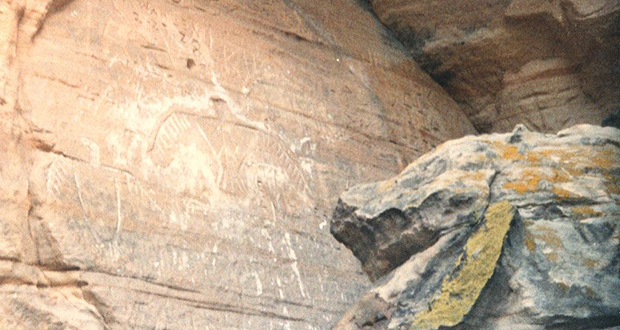
The myth of the Thunderbird in indigenous folklore may originate from pterosaur fossils found by Native Americans.
2. The earliest known modern human fossils found outside of Africa were in Apidima Cave, in Southern Greece. These fossils are somewhere between 170,000 and 210,000 years old.
3. Crinoid fossils are prehistoric remains of marine animals that appeared in the seas about 300 million years before dinosaurs. These fossils have also been found on the peak of Mount Everest, thus demonstrating that over millions of years, as a result of tectonic movement, the sea bed has ultimately been forced up to the highest peaks on earth.
4. Coprolite, fossil which is commonly used in jewelry, is actually fossilized dinosaur feces.
5. In Mongolia, scientists discovered a fossil of a prehistoric creature known as a "Murder Swan," which had a bill with teeth, claws on its feet and additional claws on flipper-like arms.
Latest FactRepublic Video:
15 Most Controversial & Costly Blunders in History
6Zhenyuanlong suni
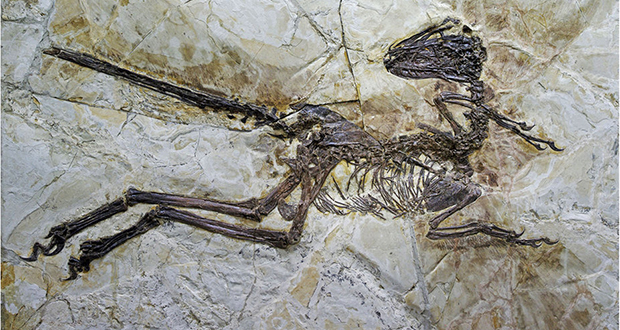
A well-preserved fossil was found in China of a dinosaur called the Zhenyuanlong suni, now the largest-known dinosaur with wings. A University of Edinburgh paleontologist dubbed the dinosaur a "fluffy feathered poodle from hell."
7. In the middle ages, toadstones were believed to be magical gems found in the heads of toads. The small 'stones' are actually the rounded fossilized teeth of an extinct fish.
8. Gigantopithecus blacki was the largest ape ever recorded. Its first fossils were discovered after being put on sale by a pharmacist in Hong Kong, listed as, “dragon bones/teeth.” It is estimated that they weighed between 300-500 kg and reached 3 meters in height.
9. In 2007, a paleontologist found the fossilized embryo of Hyphalosaurus, a small aquatic reptile. The embryo had two heads, making it the earliest known case of bicephaly.
10. Megalosaurus, a large meat-eating dinosaur, was originally named “Scrotum Humanum” because its original fossil looked like a human nutsack.
11Palaeocastor
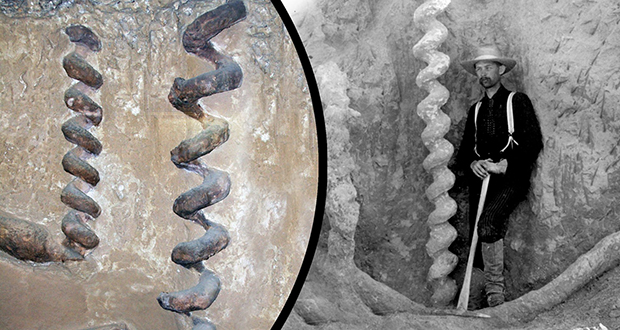
Formations called "the Devil's Corkscrew" were first found around Harrison, Nebraska, in 1891, and were once thought to be extinct forms of sea sponges, but it turns out they are actually fossilized dens of an extinct type of beaver called Palaeocastor.
12. A number of Homo Naledi fossils, found in a cave in South Africa, have the appearance of having been placed there, but this is almost 200,000 years before such activity has been documented in the Homo genus before.
13. In 2014, scientists found what appears to be a fossilized sperm cell from an ancient marine species which lived between 23 million and 16 million years ago. This is the oldest and biggest fossil of sperm ever found, at least of its kind.
14. In 2017, hundreds of fossilized Pterosaur eggs were discovered in the Gobi desert. The eggs belong to a previously known species of pterosaur that lived in China more than 100 million years ago. One such fossil suggests a wingspan of 36 feet making it one of the largest animals ever to fly.
15. The myth of the Griffin probably began when fossils of Protoceratops skulls were found in gold mines near ancient Greece.
16Atlantochelys mortoni
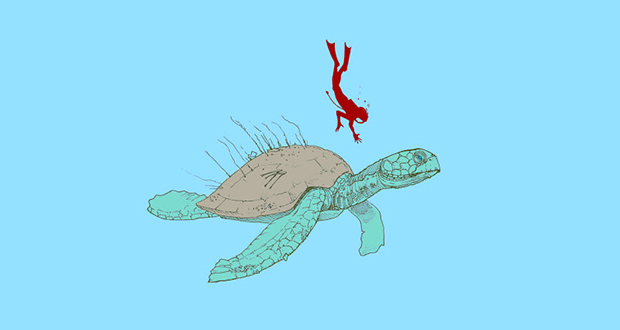
A broken humerus of a giant fossil sea turtle (Atlantochelys mortoni) was found in New Jersey in 1849. In 2012, another broken humerus was discovered, which was found out to be the other half of the exact same bone found 163 years prior.
17. Helicoprion is a genus of extinct sharks whose fossil specimens reveal spirally arranged clusters of the individuals' teeth called "tooth whorls" that resemble our modern circular saw blades. The shark's blade, connected to cylindrical muscle tissue, would shred prey into small, bite-sized pieces.
18. The oldest dingo fossils in Australia are about 4,000 years old, so dingoes’ ancestors must have reached Australia by boat. Whole-genome studies consistently place dingoes between wolves and wolflike dog breeds.
19. There is a species of dinosaur called the "Irritator". The paleontologists who named it were frustrated because illegal fossil dealers had badly damaged its skull.
20. A mysterious fossil animal from Petrified Forest National Park called Kraterokheriodon, known only from a single tooth, is so strange that it is impossible to classify what kind of animal it came from.
21Fossil rhinoceros skull

A fossil rhinoceros skull was found in a gravel pit in Klagenfurt, Austria, in 1335, and was thought to belong to a dragon. In 1590, the fossil skull was used to model a dragon statue which has been called the world's first paleontological reconstruction.
22. Dueling dinosaur fossils that shows a Triceratops and juvenile T-Rex battling to death hasn’t been available to paleontologists for 13 years after its discovery because of a legal battle between the landowners and the excavation team.
23. Paleontologists have found fossils of “Machimosaurus rex,” a prehistoric crocodile that would have been the size of a bus, at 30 feet long and weighing 3 tons. With a skull over 5 feet long, it would have been the world’s largest sea-dwelling crocodile.
24. Scientists have identified a 20-foot tall fossil in Saudi Arabia as a giant mushroom that became extinct more than 350 million years ago. It was likely the largest organism in the world at the time.
25. It's a mystery why so many birds and dinosaur fossils exhibit a 'death pose' - the characteristic posture consisting of head thrown back, tail extended, and mouth wide open.


