

26Teotihuacan City

Teotihuacan was the largest city anywhere in the Western Hemisphere before the 1400s. It had thousands of residential compounds and scores of pyramid temples, comparable to the largest pyramids of Egypt. It contains a massive central road and buildings but oddly, no military structures.
27. Vinland Map was once thought to have been a pre-Columbian map made during the Viking exploration of North America. It features a large landmass called Vinland, located in the Atlantic, which doesn’t actually exist. In 2018, after several investigations, researchers at the Yale University concluded that the map was a 20th century forgery.
28. Lacrosse has its origins in a tribal game played by eastern Woodlands Native Americans and by some Plain Indians tribes in what is now the United States of America and Canada. The game was extensively modified by European colonizers of North America to create its current form.
29. Failure to learn the Mayan nixtamalization method of preparing corn lead to Pellagra epidemics in Europe, Africa, and the southern USA. Nixtamalization frees the amino acid Niacin. Nixtamalized corn and beans are a complete protein diet and the earliest evidence of nixtamalization is found in Mesoamerican equipment dating back to 1500 B.C. Corn thus became a staple food in Central America during this period.
30. The oldest known organized ball game dates to 1500 BC in Mesoamerica. Many people played for pure sport or gambling, but certain games also held religious significance, whereby the losing team would become human sacrifices.
Latest FactRepublic Video:
15 Most Controversial & Costly Blunders in History
31Olmecs
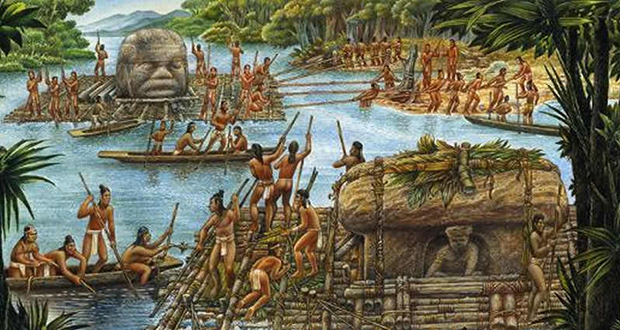
The Olmec are largely viewed as the mother culture of Aztecs and Maya but they left no written works on their belief structures. So many interpretations on Olmec beliefs are largely based on interpretations of murals and artifacts.
32. The Mapuche of South America was one of the very few tribes who successfully resisted Spanish control, staying independent for over 300 years. They called the Spaniards "New Incas," because they had successfully resisted the Incan Empire before them as well. They were only subjugated in 1883.
33. The Muisca people had two rulers (a "zipa" and a "zaque") and the line of succession was not patrilineal. The ruler's title was inherited by the ruler’s oldest nephew. Their reasoning behind this was that male parentage could be questionable, but the male ruler’s sister’s kids would definitely be of his blood.
34. The Inca created the most extensive pre-Columbian road network that was nearly 40,000 km long, even though they did not use the wheel nor had any horses. The roads were carefully planned and maintained. They were paved where necessary, had stairways, bridges and constructions such as retaining walls and a drainage system. Only 25% of the system remains visible today.
35. The Pre-Columbian population of the Americas is estimated to have been 50-100 million people. 90% of the indigenous population died from diseases which were brought by Europeans, most of whom got infected and died without direct contact with the European. This sudden population decline fueled the legend of an empty continent ready to be seized by the Europeans.


