


1Monty Hall Problem
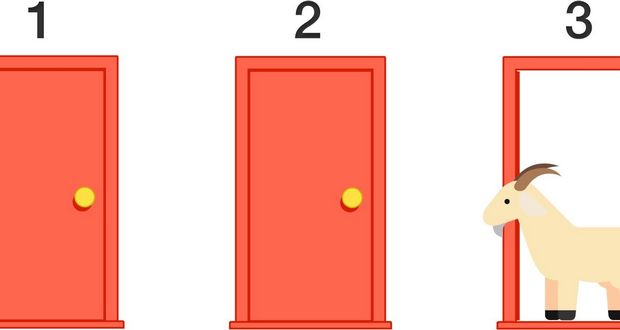
In a game show scenario with three doors-one hiding a prize and two hiding goats-switching your choice after the host reveals a goat statistically doubles your chances of winning. Despite the math, many people feel intuitively that switching shouldn't matter.
2. The aging paradox reveals that people tend to become happier as they age. Individuals in their 60s and older often report higher levels of happiness and life satisfaction compared to younger people.
3. Deutsch's Tritone Paradox is an auditory illusion in which a pair of tones separated by a tritone (half an octave) is played. Some listeners perceive the sequence as ascending in pitch, while others hear it as descending-revealing how pitch perception can vary dramatically between individuals.
4. The St. Petersburg Paradox is a thought experiment in probability where a lottery game offers an infinite expected monetary value, yet most people would pay only a modest amount to play. This gap between the mathematically calculated value and the actual amount people are willing to risk reveals the limits of expected value theory in predicting real-world decision-making.
5. The Paradox of the Plankton describes how a limited range of resources in aquatic environments supports an unexpectedly wide variety of plankton species. This seems to contradict the competitive exclusion principle, which states that species competing for the same resources cannot coexist indefinitely.
Latest FactRepublic Video:
15 Most Controversial & Costly Blunders in History
6Intentionally Blank Page Irony

The intentionally blank page paradox arises when documents include pages labeled "This page is intentionally left blank." Ironically, this statement makes the page not truly blank.
7. The paradox of thrift suggests that if everyone collectively saves money, it can actually harm the economy. This occurs because reduced spending leads to decreased demand, ultimately slowing economic growth.
8. The Diamond-Water Paradox in economics asks why diamonds command higher prices than water, even though water is essential for life. The paradox highlights the difference between total utility (overall usefulness) and marginal utility (the value of one additional unit), explaining why scarcity can make a less essential item more valuable.
9. The Decision-Making Paradox points out that choosing the best method for making a decision is itself a decision-creating a circular dilemma where the process you select depends on the very choice you're trying to make.
10. Loschmidt's Paradox challenges the Second Law of Thermodynamics, which states that systems naturally become more disordered over time, giving time a clear direction. Time symmetry in physics, however, suggests that any process can be reversed by its opposite, implying that the fundamental laws of motion do not distinguish between past and future.
11Prisoner's Dilemma: Cooperation vs. Self-Interest

The Prisoner's Dilemma illustrates a paradox in decision-making where two individuals, each acting in their own self-interest, end up with a worse outcome than if they had cooperated-highlighting the conflict between personal gain and collective benefit. For example, in the classic scenario, two suspects are interrogated separately: if both stay silent, they receive light sentences, but if each betrays the other to reduce their own punishment, both end up with harsher sentences.
12. The Grelling-Nelson Paradox classifies words as either autological (self-descriptive, like noun) or heterological (not self-descriptive, like long). The paradox arises when asking whether the word heterological is itself heterological-creating a self-referential loop with no consistent answer.
13. The Peltzman Effect describes how safety measures can paradoxically encourage riskier behavior. When people feel more protected, whether by seatbelts, helmets, or other safeguards, they may become overconfident, offsetting or even reversing the intended safety benefits.
14. The Equatorial Paradox observes that income per capita generally increases with absolute latitude, suggesting an unexpected link between geography and economic prosperity.
15. The McTaggart Paradox argues that our perception of time is an illusion. It claims that time contradicts itself yet remains necessary to perceive events as moving from past to future.
16Einstein's EPR Paradox: Spooky Action

The EPR Paradox, proposed by Einstein, Podolsky, and Rosen in 1935, highlights a puzzling feature of quantum mechanics. It shows that two entangled particles instantly adopt opposite states when one is measured, no matter how far apart they are-implying a form of "instant" connection that seems to defy the speed limit set by relativity.
17. Gabriel's Horn is a mathematical paradox in which a three-dimensional shape has a finite volume but an infinite surface area. This means it could be filled with a finite amount of paint, yet coating its surface would require an infinite amount of the paint material.
18. The Lek Paradox asks why species with elaborate mating rituals don't lose all male genetic diversity, given that females often prefer only specific traits.
19. In 1800s London, sewer-hunters scoured the city's underground waste channels for coins, jewelry, and other valuables. Paradoxically, despite constant exposure to filth and disease, many were notably strong and long-lived-likely due to immune systems toughened by years of microbial exposure.
20. The Downs-Thomson Paradox states that in congested cities, car traffic will slow down over time until it matches the average speed of public transit. As a result, expanding roads can sometimes worsen congestion by encouraging more drivers, ultimately bringing car speeds back down to transit levels.
21Alcohol Harm Paradox Explained

The Alcohol Harm Paradox reveals that poorer individuals, despite drinking less, suffer more alcohol-related illnesses than wealthier individuals who drink more.
22. In Antarctica, emperor penguins have plumage that is paradoxically colder than the surrounding air. This temperature difference reduces heat loss by minimizing the warmth radiated from their bodies, helping them survive the continent's extreme cold.
23. The "Cheese Metabolism" Paradox describes the finding that people who regularly eat fatty cheese often have healthier body compositions than expected. Researchers suggest this may be due to butyrate-a short-chain fatty acid found in cheese-that can boost metabolism, support gut health, and improve nutrient absorption.
24. The Fear of Crime Gender Paradox highlights that women generally report greater fear of street crime than men, even though statistical data shows men are more likely to be its victims.
25. The Crow Paradox highlights that crows can easily distinguish between individual humans and even hold grudges, whereas humans find it nearly impossible to recognize individual crows.
