


1Pangea's Continental Cycle
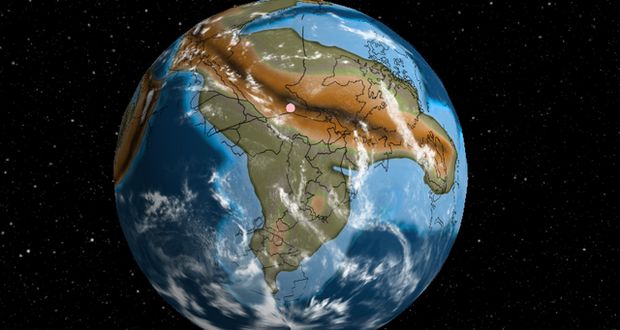
Pangea, the supercontinent that broke apart 200 million years ago to create today's continents, was at least the fifth supercontinent in Earth's cyclical history of supercontinents forming and breaking up.
2. Twelve African nations have pledged to build a 9-mile-wide band of trees spanning 4,750 miles across Africa in order to stop the Sahara's progressive advancement.
3. Antarctica is the only continent without any trees.
4. Due to its ice cover, Antarctica has the highest average surface elevation of all the continents, at around 2,000 meters above sea level. For comparison, the highest peak in the British Isles, Ben Nevis in Scotland, is 1,343 meters.
5. Ancient Antarctica was much warmer and wetter than previously suspected, with a climate suitable for substantial vegetation, including stunted trees, along the edges.
Latest FactRepublic Video:
15 Most Controversial & Costly Blunders in History
6Continental Drift Pace

Continents, on average, drift at about the same speed as fingernails grow.
7. Antarctica is approximately 1.5 times larger than the United States.
8. South America, known as the 'Bird Continent,' hosts more bird species (3,445) than any other continent, including much larger ones.
9. Alaska is the easternmost point in North America. Semisopochnoi Island, by longitude, is the easternmost land location in the United States and North America. It sits 9.7 miles (15.6 km) west of the 180th meridian, which separates the eastern and western hemispheres.
10. North America consists of 23 countries, not just three.
11Europe-Africa Proximity

Only 36 miles separate Europe from Africa.
12. North America contains both the largest oceanic island, Greenland, and the largest inland island, Manitoulin Island in Lake Huron.
13. South America was an island continent until as recently as 5 million years ago, housing many unique and now extinct animals, including saber-toothed marsupials.
14. Africa and Asia together are home to nearly 90 percent of the world's rural population.
15. Antarctica is the largest desert in the world. Scientifically, a desert is defined as a barren area with little precipitation and hostile living conditions for plant and animal life.
16Australia's Geographic Identity

Australia is the smallest continent on Earth, while Oceania is a region made up of thousands of islands in the South Pacific and is not a continent.
17. Antarctica has no time zones. So, people can set their clocks to any of the 24 standard time zones, and it will be considered correct anywhere on the continent.
18. The continent of Antarctica was originally going to be called Australia, until the colonial authorities in Sydney took the name for their continent. This left the continent of Antarctica without an official name for over 80 years until the 1890s, when it was referred to as the Antarctic Continent.
19. Australia is the world's lowest and flattest continent, with an average elevation of only 1,000 feet because it is near the center of a tectonic plate.
20. Europe and Asia aren't actually continents but two parts of one large continent called Eurasia, with the division being a historical social construct from the Ancient Greeks.
21South America's Indigenous Tribes

As of 2015, South America has 97% of the world's uncontacted tribes, while Europe, Africa, Asia, North America, and Central America together have less than 3%.
22. Without ice, Antarctica would be a giant peninsula and archipelago of mountainous islands known as Lesser Antarctica or West Antarctica, as well as a single large landmass about the size of Australia known as Greater Antarctica or East Antarctica.
23. The North American Tectonic Plate includes Greenland, parts of eastern Russia, and parts of northern Japan due to its large size.
24. South America houses all 6,000-meter or higher volcanoes, with the majority located in Argentina and Chile.
25. Earth has another continent called Zealandia, which sank after breaking away from Australia around 65-80 million years ago.
