
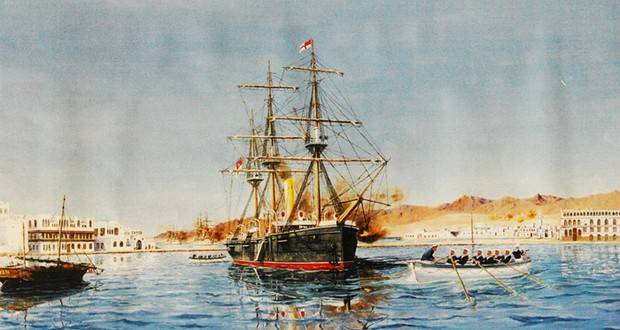
English sailors on the HMS Dolphin in 1766 discovered that native women on islands would trade sex for iron, and began pulling nails out, causing loss of the ship’s structural integrity.
Summary from Source
HMS Dolphin was a 24-gun sixth-rate frigate of the Royal Navy. Launched in 1751, she was used as a survey ship from 1764 and made two circumnavigations of the world under the successive commands of John Byron and Samuel Wallis. Built to the 1745 Establishment, Dolphin was originally ordered from the private yard of Earlsman Sparrow in Rotherhithe. In order to reduce the likely incidence of shipworm, Dolphin's hull was copper-sheathed ahead of her first voyage of circumnavigation in 1764. Dolphin was pressed into service throughout the conflict, and was present at the Battle of Minorca in 1756 when a fleet under Admiral John Byng failed to relieve Port Mahon, Britain's main base in the Western Mediterranean. Dolphin was selected as lead vessel for this voyage, and she was to be accompanied by the sloop HMS Tamar. Between June 1764 and May 1766 Dolphin completed the circumnavigation of the globe.
Later Byron visited islands of Tuamotus, Tokelau and Nikunau in the Gilbert Islands, putting them on European maps for the first time; and visited Tinian in the Northern Marianas Islands. Dolphin circumnavigated the world for a second time, under the command of Samuel Wallis. The master on this voyage, George Robertson, subsequently wrote a book The discovery of Tahiti; a journal of the second voyage of H.M.S. Dolphin round the world under the command of Captain Wallis, R.N., in the years 1766, 1767, and 1768, written by her master. Dolphin sailed in 1766 in the company of HMS Swallow, under the command of Philip Carteret, who had served on Byron's circumnavigation. Dolphin dropped anchor at the peninsula of Tahiti Iti on 17 June 1767 but quickly left to find a better anchorage. Early on a large canoe approached Dolphin and at a signal its occupants launched a storm of stones at the British, who replied with grapeshot. Dolphin's gunnery cut the canoe in two, killing most of its occupants. This trade became so extensive that the loss of nails started to threaten Dolphin's physical integrity.
